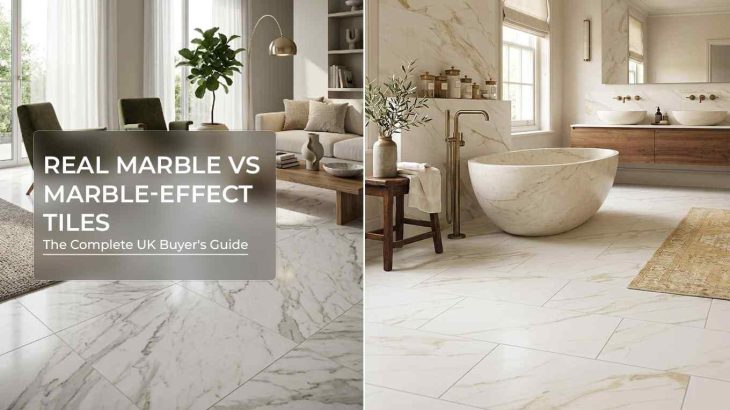
There are very few debates in UK interiors as hot as real marble vs marble-effect tiles. One is a real natural stone that has been praised for millennia; the other is a modern achievement that can fool even a trained eye at first glance.
For homeowners, architects, and contractors choosing marble flooring UK-wide, the decision usually comes to these three basic questions:
- How much are you willing to spend?
- How much maintenance do you want to commit to?
- Where in your house is the material ss actually going?
Answering these questions would basically decide for you. In this guide, we would break down real marble tiles vs marble-effect porcelain tiles for you, including a third option, faux marble, so that you can make a decision based on facts rather than showroom sales patter.
Difference Between Real Marble and Marble-Effect Tiles
Before you make any decision, it is important that you know the difference between the two to understand what you are getting into.
Real Marble Tiles
Real marble is quarried natural stone formed over millions of years from limestone under extreme heat and pressure.
The geological process is exactly what makes each slab unique from the others; the veining, the tonal variation, and mineral inclusions are different in each piece. This natural stone veining is the entire reason people pay a premium for marble tiles; they cannot be replicated, only imitated.
Marble-Effect Tiles
Marble-look tiles, by contrast, are porcelain or ceramic. Ceramic tiles are a cheaper version that can be used indoors. However, high-definition digital printing applies a marble-look pattern to the porcelain tile surface before it is fired at high temperatures, producing porcelain marble-look tiles that mimic the veining and colour variation of natural stone without compromising on the functionality.
Because porcelain tiles are manufactured, their low porosity makes them highly durable and budget-friendly, something that quarried stones cannot match. That is why marble-effect durability has become a serious talking point in its own right, not just a cost-saving compromise.
Both routes can deliver a convincing luxury marble flooring look. The difference lies entirely in what’s underneath the surface.
Want to know the difference between real wood and wood-effect tiles also? Explore: wood-effect tiles vs real wood flooring for more UK-focused comparison.
Pros and Cons of Real Marble vs Marble-Effect Tiles
Both options have their advantages and disadvantages; however, you have to choose which one you are willing to live with for the rest of its lifespan: authenticity or functionality.
Real Marble Flooring UK Homeowners Choose it for:
- Genuine, one-of-a-kind natural stone veining
- A timeless, high-status finish associated with luxury marble suppliers UK
- A cool touch underfoot; a genuine benefit in warmer months
- Long-term durability when properly sealed and maintained
Marble-Effect Porcelain Tiles UK Buyers Choose Them for:
- Lower cost per square metre than quarried stone
- Low maintenance; no sealing, no resealing schedule
- Better resistance to scratching, staining, and acid etching
- Consistent colour and pattern across a full batch, which matters for large-format floors
If you ask us, neither is objectively “better”. The pros and cons of real marble vs marble-effect tiles depend entirely on the room, the household, and the budget you have set for your space.
How to Tell if the Marble is Real
This matters a lot if you are buying reclaimed stone or marble tiles from a showroom. If you are visiting a showroom, have ordered a sample or are checking a listing that is ambiguous about the material, here is how you can check whether the marble is real or not:

- Veining: The veining on real marble runs through the material, showing slight irregularities or breaks. Printed marble effect designs repeat themselves; check multiple tiles in the same box for an identical pattern, which is a giveaway for digital printing.
- Weight: Natural stone is noticeably heavier than porcelain marble effect tiles in the same dimensions. The reason is that porcelain is fired clay rather than compressed mineral.
- Porosity: A drop of water on unsealed marble will darken the surface as it is absorbed. Porcelain is vitrified, so it makes the water droplet bead on the top.
Sealing Marble vs Marble-Effect Tiles: The Maintenance Reality
This is the point where the two materials diverge most sharply in day-to-day living.
Real marble is porous; unsealed, it will absorb all liquids, including oils, pigments, and acidic liquids like juices, leading to staining over time. That means an annual sealing routine is necessary in heavy-use spaces like kitchens. It is not optional if you want the surfaces to stay presentable and new.
Marble effect porcelain tiles, on the other hand, need none of these. The manufacturing process leaves them non-porous, so there is no need for sealant on the surface, no reapplication schedule to track, and no risk of a missed maintenance window turning into a permanent stain.
If you want the look of marble without the headache of maintenance, this is a practical answer to how to maintain marble-effect tiles vs natural marble: you largely do not have to.
Can You Use Marble in Bathrooms and Kitchens?
Yes, but with caveats that matter more in a kitchen than almost anywhere else in the house.
As Alan Hilsabeck, a certified Master Kitchen and Bath Designer, said in a video comparing real marble and faux marble, the decision should be driven by how the surface will actually be used, not just how it looks in a showroom. He explains that marble is a beautiful natural stone suited to almost any surface, but in high-traffic areas or spots exposed to acidic liquids such as wine, fruit juice, or vinegar-based cleaning products. It is genuinely vulnerable to scratching, gouging, etching and staining.
A kitchen worktop next to the hob, or bathroom floor tiles around a freestanding bath, is exactly this kind of high-exposure zone.
Faux marble, a manufactured composite of resin and marble, was developed specifically to solve this. Because it is engineered rather than quarried, the surface is harder than natural stone, making it a more meaningful choice than marble, less prone to scratching, staining, and etching in demanding environments.
For bathroom tiles and kitchen tiles specifically, marble-effect porcelain is a lower-risk and cost-effective marble alternative. You get an aesthetically pleasing luxury kitchen or bathroom space without babysitting, or a sealing schedule around splashback zones and shower surrounds. Real marble still can work beautifully in these rooms; it just demands more diligence from whoever lives there.
Faux Marble vs Real Marble: The Design Flexibility Argument
Faux marble is worth explaining when talking about marble and marble-effect tiles since they are not the same product even though both sit under the marble alternative umbrella.
Interior designer Stacey Hoffman of SYNC Design has made the point that “Today’s porcelain patterns have become extremely close to natural stone marble in appearance while remaining considerably durable and cost-effective”.
Her broader observation, that natural stone and manufactured alternatives can be mixed and matched within the same scheme rather than treated as either/or choice, is a useful reframe for anyone assuming the decision has to be binary.
Faux marble design flexibility shows up in practical ways too. Because it is manufactured, it offers versatility in sizes, finishes and colours that natural stone cannot. The offcuts generate far less waste than cutting natural slabs.
If you are weighing eco-friendly flooring solutions, such manufacturing efficiency is worth considering, as a point in favour of faux marble.
The counter-argument to marble is what it has always been: AUTHENTICITY. No manufactured product can compare to the look of the real marble tiles; this distinction alone justifies the higher cost.
Which One Should You Choose? A Buyer’s Guide
If you want to know which floor tiles option will be optimal for you, ask yourself these questions and answer them honestly:
What is the budget for your project?
If cost per square meter is the deciding factor for you, marble-effect porcelain tiles UK pricing will almost always beat real stone.
What kind of lifestyle do you have?
In busy households with kids and pets running around all day, and a kitchen that sees daily use,, durability should outweigh authenticity.
What is your maintenance appetite?
If you do not appreciate taking the time out of your busy schedule annually to reseal your floor, do not buy one that needs it.
What is your design goal?
If the brief concludes “tile as close to real as possible, whatever the cost”, real marble flooring trends in UK homes til favour Carrara and Calacatta-style slabs for exactly this reason.
If you are ready to browse your options, Royale Stones’ marble-effect tiles range covers most budgets and room types. You can either order samples online or visit a showroom before committing to a full room.
Real Marble vs Marble-Effect Furniture
The same benefits and tradeoffs extend beyond floor and wall tiles. Real marble table tops and worktops deliver the same one-of-a-kind veining as tiles, sourced through luxury marble flooring suppliers UK buyers already associate with high-end kitchens and bathrooms. However, they carry the identical vulnerability to acid spills and scratching.
Marble-effect furniture, whether porcelain-topped or resin-based faux marble, offers a lightweight and more affordable route to the same look and is easier to move, install and live with day-to-day.
For dining tables and coffee tables especially, surfaces that regularly meet wine glasses, citrus, and hot mugs, the marble effect and faux marble design options are worth considering purely on practical grounds, not just budget.
Conclusion
There is no universal answer when it comes to the choice of real marble vs marble effect tiles. The right choice depends on the given room, your budget, lifestyle, and household. Real marble delivers unmatched natural stone veining and prestige for anyone prioritising authenticity over convenience. While marble effect porcelain and resin-based faux marble deliver the same visual language with far less ongoing effort, at a fraction of the cost.
Royale Stones’ natural stone tiles collection online, and UK showrooms let you compare natural stone tiles with their porcelain version side by side under the same lighting. This is the fastest way to know which one is right for your home.
FAQs on Real Marble vs Marble Effect Tiles
What is the difference between real marble and marble-effect tiles?
Real marble is quarried and is one of the real natural stone types with colour variation, unique veining, and texture. Marble-effect tiles are man-made, manufactured through the process of vitrification at high temperature to give the almost identical look of marble but with high durability and low porosity at a lower cost than real marble.
Is marble-effect porcelain better than real marble?
Better depends on your usage, preference, and maintenance appetite. Porcelain wins on durability, maintenance, and price factors while almost replicating real marble. If you prefer authenticity and natural variation and do not mind the maintenance commitment, real marble is the best choice. For kitchens, bathrooms, and high traffic aeas, porcelain is generally the lower-risk choice.
How do you clean and maintain marble-effect tiles?
Sweep regularly with a soft brush and wipe down with clean soapy water from time to time. No sealing is required for it as it is non-porous. This is all you need to do to maintain your marble effect porcelain tiles.
Does real marble need sealing?
Yes. Real marble is porous and can stain from acidic liquids, oil, and daily use pretty quickly; thus need to be sealed on installation and annually to resist staining and maintain its original look for a long time.