
“The cloakroom is the room guests see before they see anything else. I always tell clients: if you’re going to take a risk anywhere in the house, take it in here. A small space gives you total design permission.”
Sophie Robey, Interior Designer and founder of Robey Studio, London.
This mindset shift of treating the cloakroom as a design opportunity rather than just a functional space is what makes your home feel considered. And in 2026, nowhere does that thinking pay off more than your choice of cloakroom vanity unit.
A cloakroom is the smallest room in any house, yet it is used the most by guests. That is why it deserves more than just a pedestal sink shoved against the wall. The best cloakroom vanity unit gives you a proper basin and sink in a contained unit and adds storage where you do not have any.
Today, you can find wall-hung cloakroom vanity units, floor-standing options, corner configurations, slimline and compact designs, and with classic to bold statement finishes.
Through this guide, let’s cover some of the major styles, sizes, and configurations, along with practical details that come only from working alongside tilers, bathroom fitters, and designers on real installations.
Why a Vanity Unit Beats a Pedestal Basin in a Cloakroom
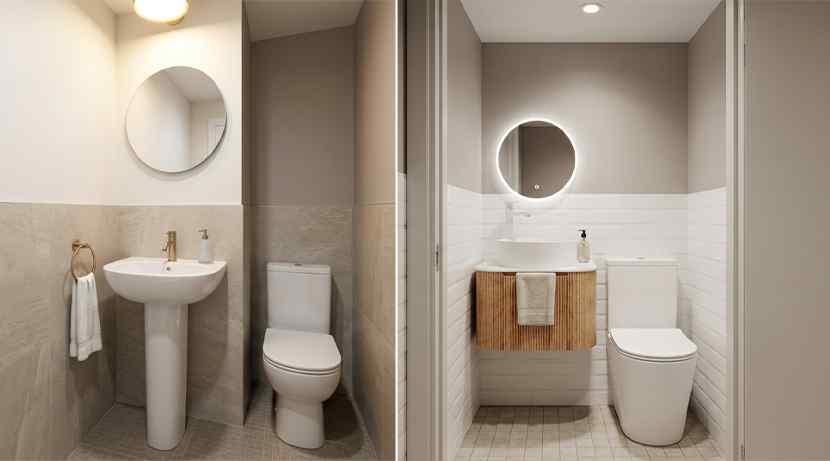
A cloakroom vanity unit utilises a small space in the smartest way possible, unlike a pedestal sink, which is merely used for washing hands.
Pedestal Sink vs Vanity Unit: Storage
A cloakroom sink and vanity unit reclaims all the dead zones and unused spaces with one or two drawers and a cupboard, or a combination of both. The soap refills, hand creams, and spare loo rolls are all accessible yet invisible.
A pedestal basin only gives you a surface to wash your hands. Underneath, all the space between the waste pipe and the floor is wasted.
Pedestal Sink vs Vanity Unit: Design
A matched bathroom vanity unit or combined vanity and toilet unit creates a cohesive look that reads as intentional rather than assembled.
On the other hand, a standalone basin stands alone, just to do the one thing it is designed for: to wash hands with no personality whatsoever.
Protip: Pair your vanity unit with toilet, fixtures, and bathroom tiles from the same manufacturer for a proper interior scheme.
Plumbing
Plumbing a bathroom cabinet vanity unit in a small cloakroom is simpler than you may assume. They do not require a fundamentally different installation than that of a standard basin.
The waste and supply connections are identical. They are simply hidden in the carcass rather than exposed beneath a pedestal. Any competent plumber can install them in a single visit.
Wall Hung Vs Floor Standing Vanity: What Actually Works in a Small Cloakroom
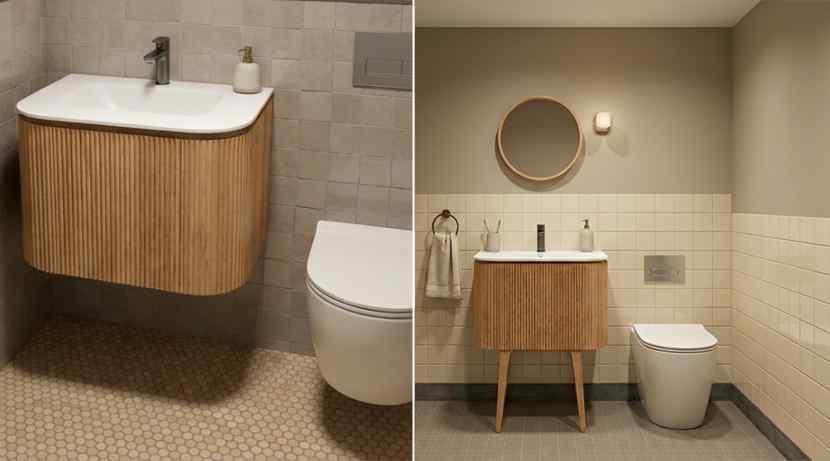
This is almost the first decision that a buyer needs to make. You must get it right before you fall in love with a specific vanity unit.
A wall-hung cloakroom vanity unit is a dominant choice in modern home renovations in 2026. The basin sits at 800-850mm from finished floor level, giving you more visible space beneath. Tiles run unbroken on the floor, with no space to trap grime, thus cleaning is significantly easier as well.
Disclaimer: For wall-hung cloakroom vanity units, a hollow stud partition wall is not sufficient on its own. You need a full-width timber noggins or a dedicated aluminium support system to hang the unit.
A floor-standing cloakroom vanity unit is a pragmatic choice for a cosmetic refresh. It needs no structural work, no wall opening up, and no plastering. It offers more storage space for the same external footprint, as there is no dead space under the carcass.
Floor-standing vanity units suit traditional and countryside large bathrooms more than a modern cloakroom, where floor space is already scarce.
Practical Verdict
Go for a wall-hung vanity if you are doing a full contemporary refurbishment. If you are updating a room without touching the walls and the floor, floor-standing is a sensible choice.
Cloakroom Vanity Unit Sizes: Getting the Dimensions Right
Size selection isn’t just an aesthetic question in a small cloakroom; it’s a spatial one.
| Unit Size | Best For | Compatible Basin | Minimum Room Width | Key Benefit |
| 500mm wide | Most standard UK cloakrooms | Semi-recessed or countertop basin (430–480mm) | 1.5m+ | Most popular size; the middle ground that works for the majority of installations |
| 400mm wide | Genuinely compact rooms | 350mm offset basin or countertop vessel bowl | 1.2m–1.5m | Frees up 100mm of extra clearance — a meaningful gain in a tight room |
| 300mm depth (slimline/compact) | Rooms where the WC pan sits directly opposite the vanity wall | Typically, a narrow inset or compact countertop basin | Any width where projection is the constraint | Minimises wall-to-wall clearance issues; better designs conceal the waste trap inside the carcass |
Before You Specify: Always measure projection from the wall first, not width. Depth is the dimension that determines whether the door opens freely — and whether the room feels usable once everything is in it.
UK Building Regs Reference: Minimum cloakroom floor area is 1.2m × 900mm. Most designers work to 1.5m × 800mm as a practical comfort minimum.
Cloakroom Vanity Unit Styles: Minimalist, Traditional, and Everything Between
The cloakroom is one of the best rooms for committing to bold designs. The contained space lets dark colours, unusual tiles, and standout fixtures seem curated rather than overwhelming.
Modern and Minimal Units
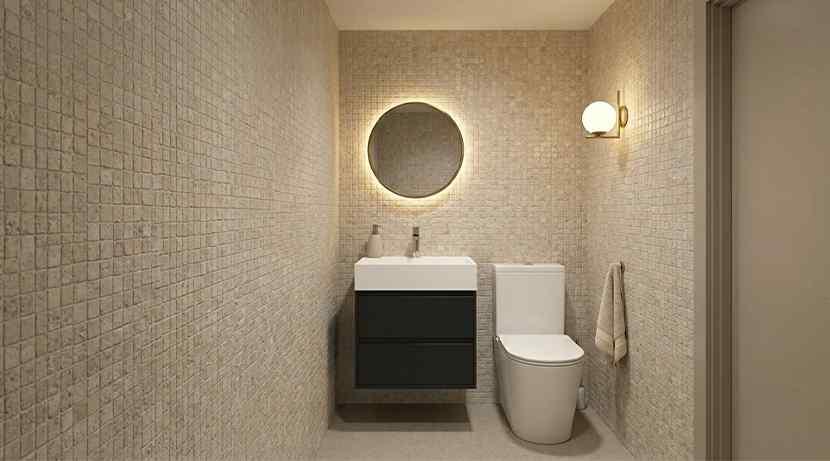
Contemporary and minimalist units are characterised by smooth finishes, handle-less soft-close doors, ultra-matt lacquer, and a clean horizontal profile that suits all floating and wall-hung installations.
They pair really well with large-format porcelain floor tiles, frameless mirrors, and minimal hardware. If the aesthetics of your wide cloakroom run in Scandi or Japandi, a minimal vanity unit is your natural direction.
Traditional and Shaker-style Units
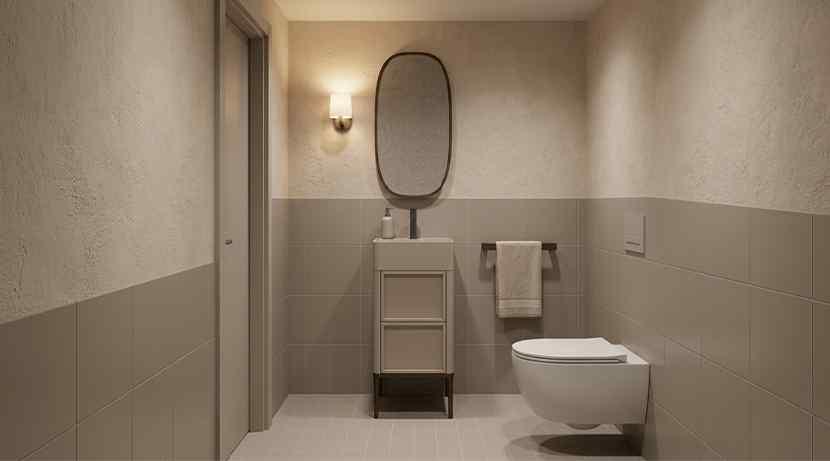
Traditional vanity units bring warmth and familiarity to any bathroom, including cloakrooms. The traditional cloakroom vanity unit uses in-frame or shaker-style door construction in MDF or solid wood to give the space a framed and neat look.
Pair your traditional cloakroom vanity unit with metro wall tiles, terrazzo floor tiles, and brass hardware for complementary styles.
Disclaimer: Chrome shows watermarks easily in high-traffic cloakrooms. Thus, always specify solid brass or bronze hardware rather than chrome-plated.
When it comes to colour, in 2026, black cloakroom vanity units have continued to be a firm fixture since 2022 and show no signs of fading. In small spaces, high contrast reads as intentional rather than heavy.
Green cloakroom vanity units are the breakout story of 2025-26 with sage, forest, and deep olive tones, performing strongly. Olive green combined vanity and toilet unit works beautifully against terracotta floor tiles, pale stone effect porcelain, and floral green and orange wallpaper.
Black and green units suit wall-hung or floor-standing configurations without issues. The only design principle that works in a small room is to commit to one bold material and make other things work around it quietly.
Corner Units, Compact Combos, and Toilet Pairings
A corner cloakroom vanity unit is one of the most space-saving solutions that only designers point out. It brings life to the dead diagonal corner, freeing flat walls for WC pan and additional storage.
Corner Vanity Unit
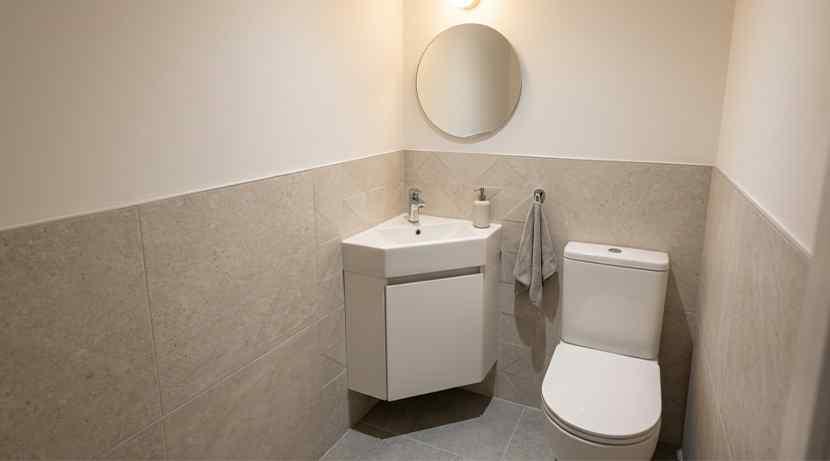
A cloakroom corner vanity unit measures 400-500mm on each arm, where the basin is angled or centred in the corner. You can find wall-hung and floor-standing versions; both versions save usable floor space significantly.
Slimline and Compact Units
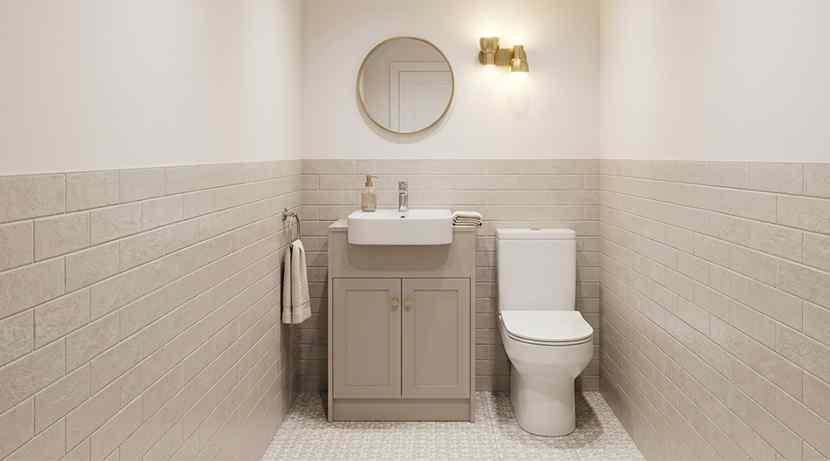
A slimline cloakroom vanity unit, a cloakroom slim vanity unit, and a compact cloakroom vanity unit are the same name for a unit with sub-300mm projection. It prioritises depth reduction over storage volume.
Designers use these units to specify when the room is genuinely right, given the limited space clearance due to the WC pan on the opposite wall.
Combined Toilet and Vanity Unit
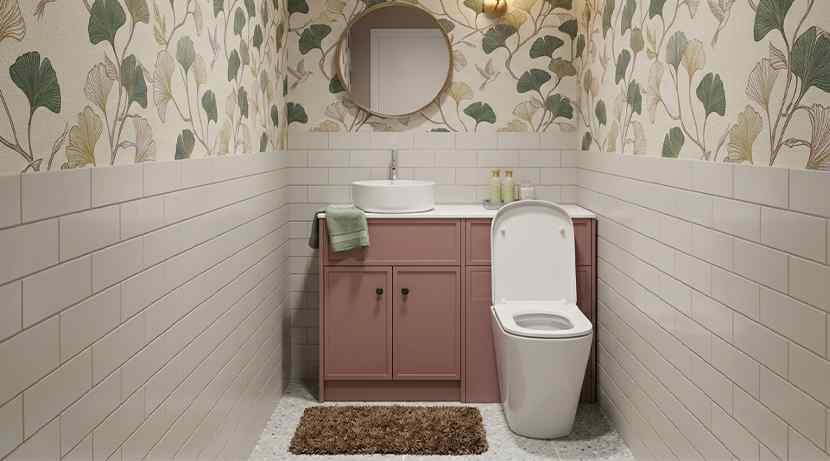
It is one of the most demanding products of Royale Stones for the 2025-26 trends. A cloakroom vanity unit and toilet eliminate guesswork entirely.
Most bundles include back-to-wall WC pans, a concealed cistern and a matching bathroom vanity unit attached to it in a single purchase.
The toilet and vanity unit combination works out cheaper than specifying components separately and gives a coherent visual result. If you are finding a bathroom specification daunting for your cloakroom, combined vanity and toilet units are a great starting point.
Installation Considerations Before You Buy
Here are a few practical points that rarely appear in product listings but matter enormously on site:
- Choose a Pre-fitted Basin if Possible: There is no countertop cutting, no silicone joints, no misalignment risk. If you are buying a ceramic or marble basin separately, confirm compatibility with the unit first.
- Check Waste Outlet Position Before Ordering: If your waste runs through the floor rather than the wall, most slimline units won’t have sufficient internal depth for angled bottle traps.
- Insist on Soft-close Hinges: Soft-close doors and hinges should be a standard in any mid-market unit in 2026. If the listing doesn’t specify, ask. A slamming door in a tiled room is a daily irritation no one asks for.
- No Compromise on Carcass Construction: Mr-grade MDF or PVC foil board is a non-negotiable. Standard MDF swells and fails over time, no matter how good the front door seems.
Conclusion
Your cloakroom is small but not unimportant. With the right cloakroom vanity unit, you can make your small bathroom not only functional but visually pleasing.
You can choose from a wall-hung cloakroom vanity unit for the floating effect, a corner unit to reclaim dead space, a slimline design to make a tight room work, or commit to a black or green finish for a room that genuinely reflects your taste; the options are endless.
Browse by style, size, or explore a combined vanity and toilet unit today, and start your renovation adventure!
FAQs About Cloakroom Vanity Units
How to style a small cloakroom?
Use matt black, deep green, or warm painted tone to make it stand out and anchor the room instantly. Keep the walls simple and lay a single strong patterned tile. Add a mirror and lights for reflection and a brighter space. Consistent hardware across the room ties everything together without doing much.
How to make a downstairs toilet look nice?
Replace the standard pedestal basin with a proper wall-hung cloakroom vanity unit with basin. Retile the floor and paint the walls. Among the floor and wall, keep either the floor or one wall as a focal point and give the cloakroom a genuine character. Add a statement mirror and use a consistent finish on hardware. If the WC pan looks old and tired, replace it. Insert frames and some plants as a finishing touch.
How to add personality to a cloakroom?
Adding a green, black or navy blue cloakroom vanity unit signals a considered interior POV without dominating the whole cloakroom space. A bold or patterned wallpaper, tile or paint adds visual interest that feels characteristic.
How can I maximise a small cloakroom?
Go for a wall-hung small vanity unit; for smaller rooms, a corner vanity unit also works well. For a lower projection, choose a slimline vanity unit. For maximising storage and invisible clutter, add a cabinet mirror on the top of the vanity unit.