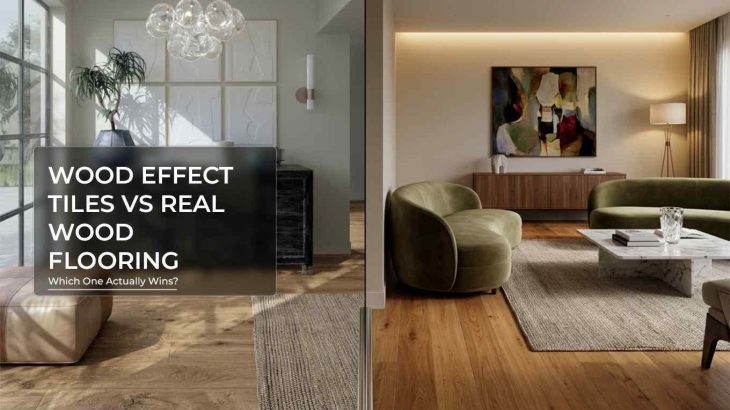
For bathrooms, kitchens and hallways, wood-effect porcelain tiles are the more practical choice for most UK homes. For living rooms with stable subfloors and no underfloor heating, real wood remains worth the investment.
Here’s why and where each one falls short.
Where Real Wood Genuinely Wins
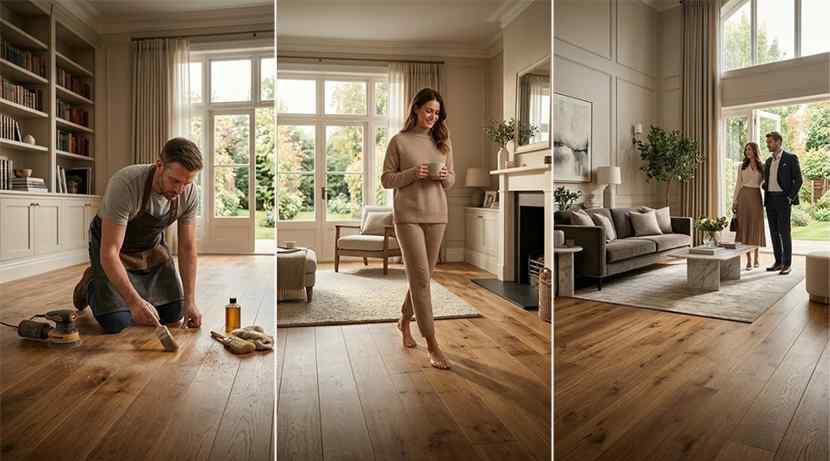
Before you make a case against real wood and in favour of porcelain wood-effect tiles, it is worth being straight about what timber or wood does better for UK homeowners.
“Modern-day wood flooring has a much longer finish than traditional installer-applied finish. Which means you can go years longer without ever needing to refinish your floors ”
KBF Design Gallery
Repairability
Ease of repair is one of real wood’s strongest arguments. If scratched or dented, hardwood floors can be sanded back and refinished. Real wood can go through this process multiple times over its lifetime, and we have seen people restoring fifty-year-old real wood flooring on social media. Engineered wood flooring has a thinner top layer but still allows one or two refinishes.
With porcelain, a chip or crack means replacing the whole tile, and in case of discontinuation of the batch, matching tile replacement is quite difficult.
Warmth Underfoot
The warmth of real wood is a genuine advantage that people love, and it is not just a perception of warmth. Timber has a lower thermal mass than porcelain. That is the reason that it absorbs heat and feels warmer to bare feet on a colder morning.
Tiles feel colder, even with underfloor heating systems. Although UFH has largely closed this gap.
Resale Sentiment
It is harder to quantify, but many UK buyers (40+ age demographics) still associate quality with wood floors that tiles can’t fully replace. Whether that sentiment reflects reality, it is debatable, but real estate agents will tell you it’s real.
Where Wood-Effect Porcelain Tiles Get Ahead
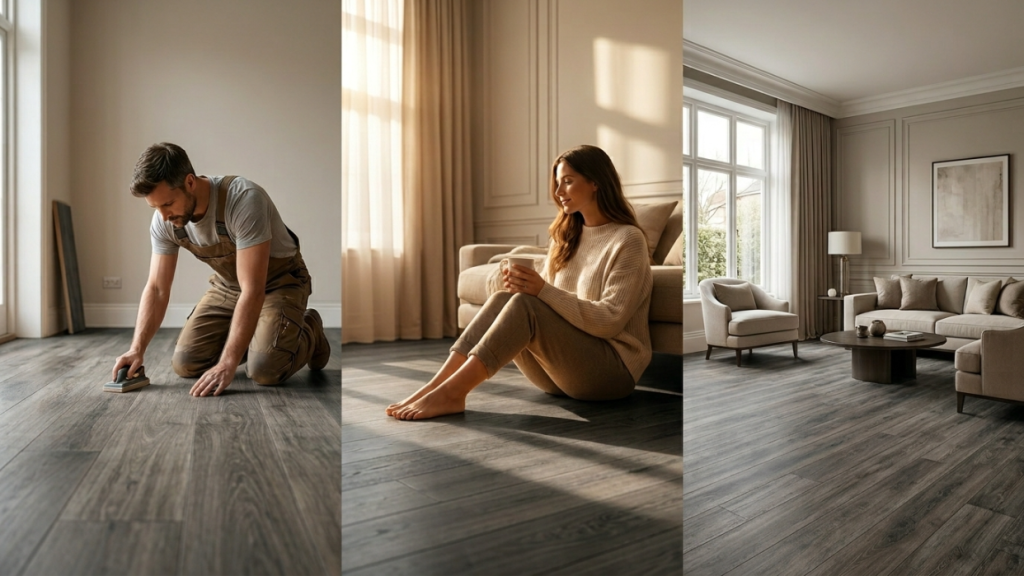
That said, for most UK homes, the case of porcelain wood-effect tiles is strong, and it is not primarily about cost.
“If durability is at the top of your list in selecting your floors, you are right to select a wood look or porcelain tile, as nothing beats the durability of the tile: it is stain, water, and scratch resistant.”
KBF Design Gallery
Moisture Resistance
It is the clearest win. Real wood and damp weather conditions are one of the worst combinations. Sold hardwood flooring in moisture warps, cups and stains, especially in bathrooms.
Engineered wood performs better but still carries risk around wet rooms, around island units in the kitchen and in hallways where wet boots and coats come through the door.
Porcelain floor tiles are impervious to moisture. Full stop.
Underfloor Heating Capability
It is a related point. Timber flooring, particularly solid wood, has strict limitations around UFH because of its thermal movement.
Porcelain carries no such restrictions. Porcelain indoor floor tiles, including Wood effect, conduct heat efficiently and pair well with wet and electric underfloor heating systems. It means in modern open layout kitchens, dining and living zones, porcelain is desirable alongside underfloor heating.
Scratch and Wear Resistance
Solid wood, or in general, timber, is easily refinished if any stain or scratch accidents happen, but what if there are no stains or scratches at all? Porcelain comes with a PEI rating of 4-5 for floor tiles.
Busy households with children, dogs and frequent footfalls benefit greatly from a well-chosen porcelain tile, which seems to look the same in fifteen years as it does today.
Long-Term Cost
Long-term costs are more nuanced than a simple price-per-m² comparison; however, it is worth breaking down honestly.
Quality solid hardwood flooring costs roughly £50–£100/m² for material alone, and with installation, add another £30–£50/m² to the equation.
Mid-range porcelain wood effect tiles typically range from £30 to £60/m² comparable installation costs, depending on labour regulations in your area and the time of publishing this article.
The bigger differential comes over time: timber needs extra care, refinishing, resealing time and again over time. It is also susceptible to replacement if water damage occurs. The lifetime costs of real wood in a kitchen or bathroom are substantially higher than those of wood-effect tiles.
More on why to choose wood-effect tiles for the floor: 7 Reasons Wood-Effect Tiles Are a Top Choice for Flooring
Wood-Effect Tiles vs Real Wood: A Quick Comparison
| Factor | Real Wood | Wood-Effect Porcelain |
| Moisture resistance | Poor–moderate | Excellent |
| UFH compatibility | Limited | Full |
| Repairability | High (refinishable) | Low (replace tile) |
| Warmth underfoot | High | Moderate |
| Long-term cost | Higher | Lower |
| Scratch resistance | Moderate | High (PEI 4–5) |
Grout Line in Question
Grouting is an issue that most homeowners dread, and it deserves an honest clarification.
Grout lines are visible on wood-effect tiles. On a standard brick-lay pattern, 2-3mm joints are easily noticeable. On long-format plank tiles laid with a minimal 1-1.5 grout lines in a matching colour, recede almost entirely.
The question is not whether grout lines exist or not; they do. The question is whether they are distracting or not, and that depends heavily on the tile format, layout and grout choice.
The other half of this conversation is whether you can differentiate between a well-specified porcelain and real wood.
The advanced porcelain printing technology has produced options like oak effect floor tiles and walnut effect tiles which replicate grain depth, knot details and tonal variations convincingly. Side by side, most people cannot even tell the difference at floor level. It is not a sales claim; it is a function of how far ceramic and porcelain printing technology has come.
Room-by-Room Comparison: Which One to Choose
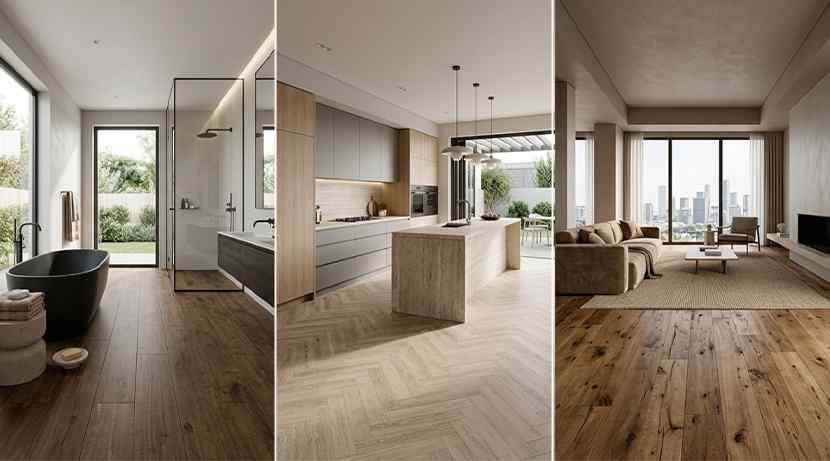
Among wood-effect tiles and real wood, there are indoor spaces where one makes more sense than the other. For instance:
Bathroom: Wood Effect Tiles
Wood-effect bathroom tiles are stronger without question. Real wood does not tolerate moisture, and porcelain wood-effect tiles have a water absorption level of less than 0.5%, which makes the choice pretty clear.
Kitchen: Wood Effect Tiles
Tiles are more practical, especially in open-plan layouts. If continuity with an adjoining living space is a priority, kitchen floor tiles in a consistent wood look format, carrying the design through without the risk of a timber to tile threshold.
Living Room: Real Wood
This is where real wood makes its strongest case. Low moisture exposure, more barefoot time and greater aesthetic appeal payoff from the real thing. If the budget allows and the subfloor is stable, timber is worth considering. If underfloor heating is installed, porcelain wins again.
Hallway: Wood-Effect Tiles
The combination of wet footwear, heavy traffic and awkward geometries makes hardwood flooring a liability. Hallway floor tiles in long-format wood plank designs handle the punishment and look coherent from the front door through to the kitchen.
The Final Verdict
Choose wood-effect porcelain if: you have underfloor heating, wet rooms, high footfall, or an open-plan layout where consistency matters more than material authenticity.
Choose real wood if: it’s a living room or bedroom, your subfloor is stable, you don’t have UFH, and you’re prepared to maintain it.
If you are weighing your options, Royale Stones’ wood-effect collections include large-format plank tiles, herringbone wood-effect tiles, and a large range of finishes, including Nordic Oak to Walnut. Buy samples to check the realism in your own lighting before committing to full packs.
This guide was reviewed against current UK flooring market pricing as of January, 2026.
Frequently Asked Questions
Do wood-effect tiles look realistic?
Modern wood-effect porcelain tiles are highly realistic, and most people cannot distinguish them from timber at floor level. Advanced inkjet printing technology replicates grain depth, knot detail and tonal variation across multiple faces, so repeat patterns are not obvious. Large-format plank tiles are the most convincing because the longer format mirrors real timber boards. The difference becomes more apparent on close inspection or when handling individual tiles before installation.
What grout colour works best with wood-effect tiles?
A grout colour that closely matches the tile’s base tone will produce the most seamless, wood-like finish. For light oak or Nordic-style tiles, warm grey or sandy beige grout recedes visually. For darker walnut or smoked finishes, a charcoal or dark brown grout maintains continuity. Avoid stark white grout with any wood-effect tile; it emphasises joint lines and breaks the illusion that the tile is working hard to create. Unsanded grout in a 1–2mm joint width gives the cleanest result.
Which is better for underfloor heating: wood or tiles?
Porcelain tiles are significantly better suited to underfloor heating than real wood. Timber, particularly solid hardwood, expands and contracts with temperature changes, which places stress on the floor and restricts the maximum UFH output you can safely run. Porcelain has no such limitation: it conducts heat efficiently, retains warmth longer and places no restrictions on system temperature. Engineered wood is more tolerant than solid wood but still carries manufacturer constraints. For any room with UFH as the primary heat source, porcelain is the more reliable choice.
Can you mix wood-effect tiles with real wood flooring?
Yes, and in open-plan layouts it is increasingly common, but it requires deliberate planning to avoid a disjointed result. The most successful approaches either match the tone closely so the transition reads as intentional, or use a clear threshold or design break, a change in layout direction or a metal strip to signal the material shift. Mismatched undertones are the most common mistake: a cool-toned tile next to a warm timber will look like an accident rather than a design choice. Sample both together in your actual lighting before committing.