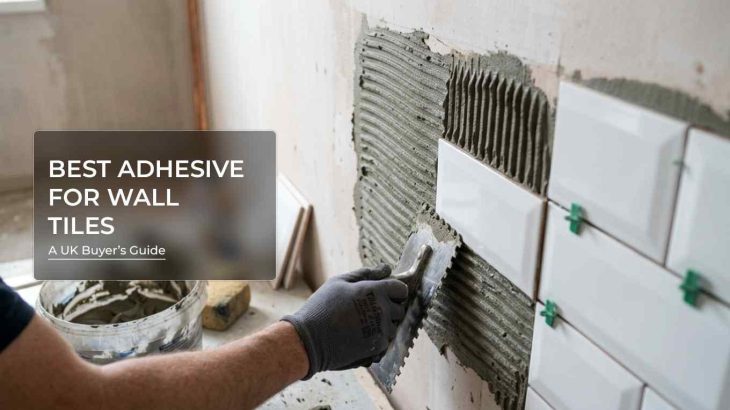
Choosing the wrong wall tile adhesive single-handedly fails a whole wall tile project. Not a bad tiling technique, not the cheap tiles, just the wrong bag or tub under the tile, and you have already made your way to book another appointment with your tiler for repair.
A tile that is debonded six months after the installation almost always traces back to the mismatch between the adhesive type, substrate and tile weight rather than poor workmanship.
This guide breaks down exactly which adhesive to use for which tile job, how UK adhesive classifications work and where most people go wrong.
Cement-Based vs Ready-Mix vs Reaction Resin
All of the tile adhesives fall into three base types under BS EN 12004, the British and European standards that govern adhesive performance in the UK.
| Code | Type | Format | Best for | Limitations |
| C | Cementitious | Powder, mixed with water on site | Default for most wall tile projects; porcelain, natural stone, large-format tiles, anything heavier than standard ceramic sized 300mm | Requires on-site mixing |
| D | Dispersion | Ready-mixed, in a tub | Small ceramic wall tiles in dry internal areas | Not rated for wet rooms, floors, or porcelain; pushing it beyond that scope is the fastest way to get bond failure |
| R | Reaction resin | Polyurethane or epoxy-based, cures via chemical reaction | Highly waterproof, chemical-resistant applications | Overkill and expensive. For a standard domestic bathroom wall |
Tile Adhesive vs Tile Cement
People use these two terms interchangeably, but they are not the same. Here is the actual difference:
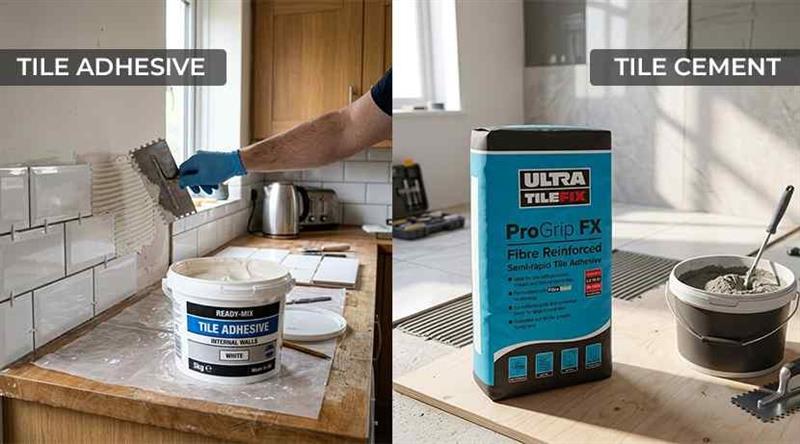
Tile Adhesive (Ready-Mix)
Suitable for: Small tiling projects, feature walls, kitchen backsplashes and areas where convenience and quick application are the priority.
It is the pre-mixed option. Think of it as the superglue of tiling. Open the tub, apply and be done. Best for smaller jobs such asbathroom feature wall tiles, kitchen backsplashes; anywhere precision and convenience matter more than raw strength.
The only downside is that it dries pretty quickly. Thus, you need to keep everything else ready before you open the tub and start applying it. Best if you want to get the job done fast.
Tile Cement (Powdered)
Suitable for: Large-scale tiling projects, floors, full bathroom installations and heavier tiles such as porcelain wall tiles.
It is the mix-it-yourself option that you need to blend with water. It is stronger and more durable, and more cost-effective at scale. This makes it a standard for large walls, floors, and heavy-duty projects.
If you are tiling a small feature wall, ready-mix tile adhesive is fine. For a full bathroom tiling project or projects using porcelain wall tiles, go powdered – full stop.
Why Powder-Modified Adhesive Is Usually the Right Call
For most wall tile installations in the UK, tilers use polymer-modified, cement-based (powdered) adhesive as a safer default.
Polymer modification adds flexibility and bond strength that plain cementitious adhesive doesn’t have. It matters more than most people assume, as it factors in real-world wall conditions, like plasterboard flex, thermal movement and minor settlement.
For heavier or denser tiles, particularly porcelain, look for C2-rated adhesive specifically. C2 adhesives are the improved performance tier under BS EN 12004, and they exist precisely because porcelain is non-porous, making it harder to bond than standard ceramic. Always check the tile manufacturer’s own spec sheet before buying. A manufacturer’s stated requirements override general guidance every time.
Why It Is Important to Use the Right Adhesive
A well-matched wall tile adhesive, including other tile adhesives, isn’t just “sticky”. It plays several important roles in creating a secure and long-lasting tiled surface.
The key factors that highlight the importance of choosing the right wall tile adhesive include:
- Bond Strength: Enhanced cementitious adhesives achieve tensile adhesion strength above 1.0 N/mm², which is what porcelain, ceramic, and natural stone all require to stay put long-term.
- Substrate Movement: Flexible adhesives absorb the natural movement in timber floors, suspended floors, and heated screeds; surfaces that expand, contract, and flex in ways solid masonry doesn’t.
- Moisture Resistance: Water-resistant formulations hold their bond in kitchens, bathrooms, and wet rooms, where standard adhesive can fail over time as it repeatedly absorbs and releases moisture.
- Tile Absorption Rate: Porcelain absorbs below 0.5% water; ceramic absorbs between 3–10%. That’s a significant gap, and it’s why the same adhesive can’t reliably serve both.
- Thermal Conditions: Underfloor heating surfaces can reach up to 27°C, which requires an adhesive with enough deformability to handle repeated expansion and contraction without cracking.
Understanding BS EN 12004 Classification
Every tile adhesive sold in the UK is coded against BS EN 12004, and once you can read the code on the bag, choosing correctly gets easier than you might think.
1. Base Material
- Code C: Cementitious (powder), the most common for walls and floors
- Code D: Dispersion (ready-mixed paste), best for internal walls and small ceramic tiles only
- Code R: Reaction resin, waterproof and chemical-resistant
2. Performance Level
- 1: Normal, tensile adhesion strength ≥ 0.5 N/mm²
- 2: Improved, tensile adhesion strength ≥ 1.0 N/mm², required for low-porosity tiles like porcelain
3. Special Characteristics
- F: Fast setting, ready to grout within hours
- T: Thixotropic/slip-resistant, stops wall tiles sliding before they cure
- E: Extended open time, slower drying for larger areas or less experienced installers
4. Flexibility
- S1: Deformable (2.5–5mm), suited to timber floors, underfloor heating, and standard wet areas
- S2: Highly deformable (5mm+), for high-vibration or heavy structural movement situations
For instance, a product coded C2TE S1 means an improved cementitious adhesive (C2) with slip resistance (T), extended open time, and standard flexibility (S1). By the way, it is a solid all-rounder tile adhesive code that most UK bathroom wall installations require.
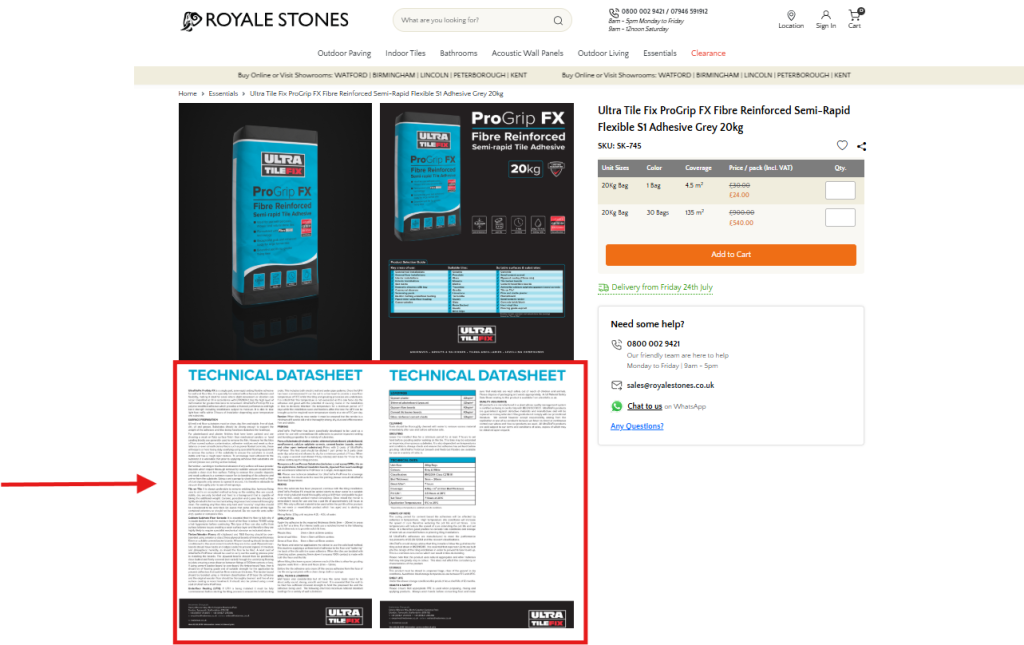
If you want a real-world example of a fibre-reinforced S1 adhesive built for exactly this kind of job, Royale Stones’ Ultra Tile Fix ProGrip FX is worth a look.
Best Adhesives for Floor Tiles
Floor tiling has different demands than walls; foot traffic, heavier tile formats, and often underfloor heating, so the adhesive needs to work harder.
- Powdered cement-based adhesive is close to non-negotiable for floors. It’s the only format with the bond strength and coverage to support porcelain and large-format floor tiles reliably.
- C2 rating is standard for most floor jobs, and essential for porcelain.
- S1 flexibility is required wherever there’s a timber subfloor, a suspended floor, or underfloor heating, since the adhesive needs to absorb movement the substrate itself creates.
- Ready-mix adhesive is not suitable here. It isn’t rated for tiles over 300mm, and most floor tiles exceed that.
Browse the full range of floor tiles to check size and weight before matching an adhesive to your project.
Mixing Powdered Adhesive for Wall Tiles: What You Need and How to Stay Safe
Royale Stones’ Powdered adhesive is straightforward to mix and use; however, it is alkaline dust, so it needs to be treated with basic respect.
Safety Kit for Mixing Powdered Adhesive
- Gloves
- Dust mask
- Eye protection
Equipment
- A clean bucket
- A paddle mixer attachment and drill
- Clean, cold water
How to Mix Powdered Wall Tile Adhesive
Here is the accurate way of mixing powdered wall tile adhesive:
Step 1: Add water to the bucket
Step 2: Add powder to the water (Not the other way around)
Step 3: Mix until you reach a consistency like peanut butter, not melted ice cream.
Too wet and the adhesive will not hold its ridges when combined (In this case, add more powder until desired consistency is achieved). Too dry, and it will not bond properly. (In this case, add more water until the desired consistency is achieved.)
Choosing Wall Adhesive By Room
For bathroom walls and kitchen backsplashes, prioritise a water-resistant, polymer-modified cementitious adhesive. This is where a strong adhesive for porcelain wall tiles or a reliable waterproof adhesive for kitchen wall tiles earns its keep. This is because these areas see the most repeated moisture exposure.
Browse our bathroom wall tiles and kitchen tiles before you commit to either.
For large-format wall tiles, an S1-rated flexible adhesive with extended open time (E) gives you room to reposition tiles before the adhesive skins over. It is important given how unforgiving large tiles are to reposition once set.
Our guide to how large wall tiles change the look of interiors covers sizing considerations in more depth, and our piece on standard tile sizes for UK homes is a useful companion if you haven’t decided on the tile size yet.
FAQs About Wall Tile Adhesives
What is the best adhesive for bathroom wall tiles?
A polymer-modified, water-resistant cementitious adhesive, ideally C2-rated, is the best adhesive for bathroom walls, especially if you’re using porcelain. Ready-mix tile adhesive is ideal for small ceramic tiles in low-moisture zones, but it’s not the safer default for a full bathroom wall.
Can I use floor tile adhesive on walls?
Generally yes. Floor adhesive is typically higher-spec with C2 strength than wall adhesive, so it will usually perform well on a wall. The reverse isn’t true: standard wall adhesive is not strong enough for floor use due to heavy foot traffic and higher usage.
How long does tile adhesive take to dry?
Standard adhesive typically needs 24 hours before grouting; however, fast-setting (F-rated) adhesive can be ready in as little as 1–3 hours. Always check the specific product’s technical data sheet, as cure times vary with temperature and humidity.
Do I need flexible adhesive for large format wall tiles?
Yes, in most cases. S1 flexibility helps absorb the minor substrate movement that becomes more visible. Flexibility is also important because its absence can cause the tile to crack as tile size increases.
What’s the difference between ready-mix and powdered tile adhesive?
Ready-mix adhesive comes pre-mixed. They are convenient to use for small ceramic tiles in dry areas. Powdered adhesive is mixed on-site using a bucket, clean water and a mixer. It is stronger and more versatile for porcelain wall tiles and floor tiles, large-format tiles, and anywhere with moisture or substrate movement.