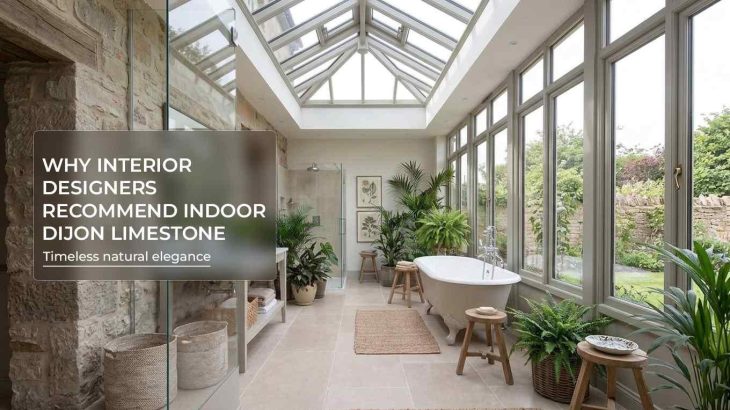
Quick Answer: Designers specify Dijon Limestone for its warm, light-diffusing matte finish and genuine tile-to-tile variation, which suit both period and contemporary UK homes. It’s also practical underfoot; compatible with underfloor heating and durable in high-traffic rooms once properly sealed.
Among natural stone flooring UK options, Dijon Limestone has become a recurring specification in UK interior design briefs, and not by accident. It is the material that never goes out of style. The warm earthy tone, subtle fossil detailing, and soft lived-in texture make it effortlessly beautiful in modern UK homes as much as in a country kitchen or hallway.
This piece looks at why designers keep returning to Dijon Limestone tiles, how it performs in British homes specifically, and what homeowners and contractors need to know before specifying it as indoor tiles.
What is Dijon Limestone
Just like any other natural stone, it is a sedimentary rock formed largely from calcium carbonate, laid down over millions of years from compressed marine sediment and shell fragments.
Dijon limestone sits within the honey to beige colour range, showing warm tan and soft ochre tones with subtle fossil inclusions and tonal variation from tile to tile. It is not a manufacturing flaw but a natural characteristic, putting it firmly in the neutral stone flooring and warm beige floor tile category, different from cooler tones, which are common in porcelain ranges.
Because each floor tile is cut from quarried stone rather than produced to a fixed pattern, Dijon Limestone reads as a rustic limestone tile with genuine material depth: fine fossil detail, mineral veining, and a matte, low-sheen surface that behaves very differently under light compared with a printed or glazed alternative.
Finishes, Edge Profiles and Colourways: The Design Details
The design decision that actually shapes a room happens at the finish and profile level, not just the choice of the stone.
Tumbled & Honed Finishes
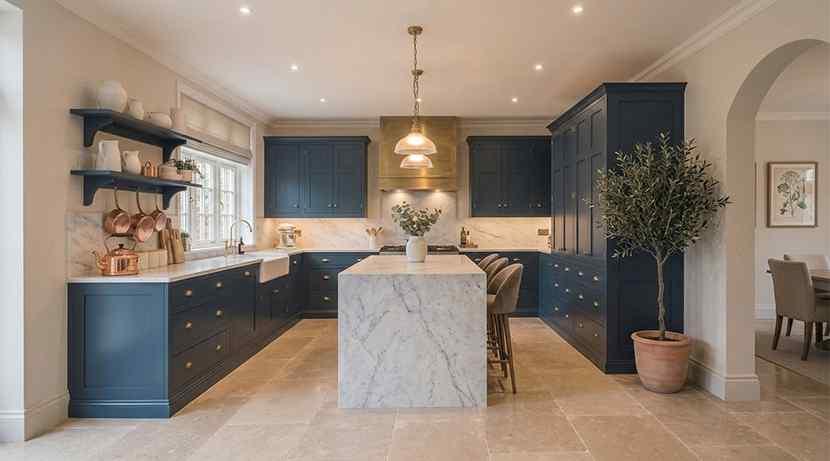
Dijon tumbled limestone has softened, slightly irregular edges and a worn, aged surface texture produced by mechanically tumbling the tile after cutting. Dijon tumbled limestone indoor application suits period homes and rustic schemes where lived-in reclaimed character is the goal.
A honed finish, by contrast, keeps crisp edges and a flatter, more modern surface, which is a better choice for minimalist or new-build interiors where uniformity matters more than texture.
Bullnose Edge Profile
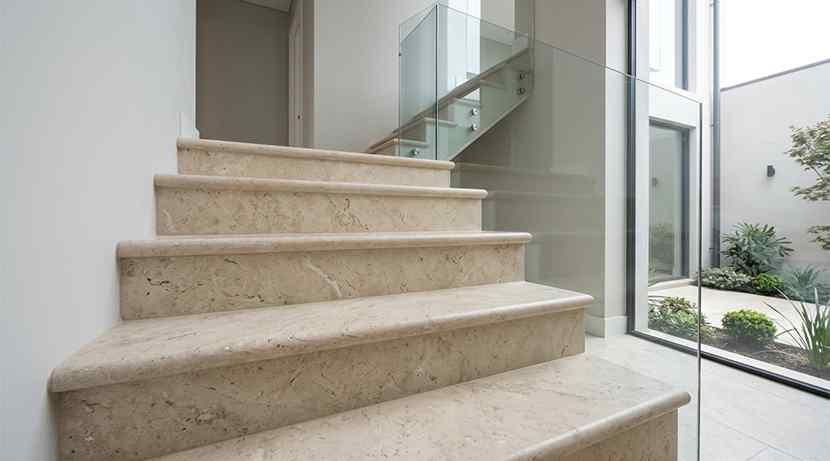
Dijon Limestone Bullnose tiles have a rounded, polished edge rather than a square cut, typically specified for step edges, window sills, and shower or wet room thresholds where a sharp tile edge would otherwise be a safety and comfort issue underfoot.
Grey Limestone
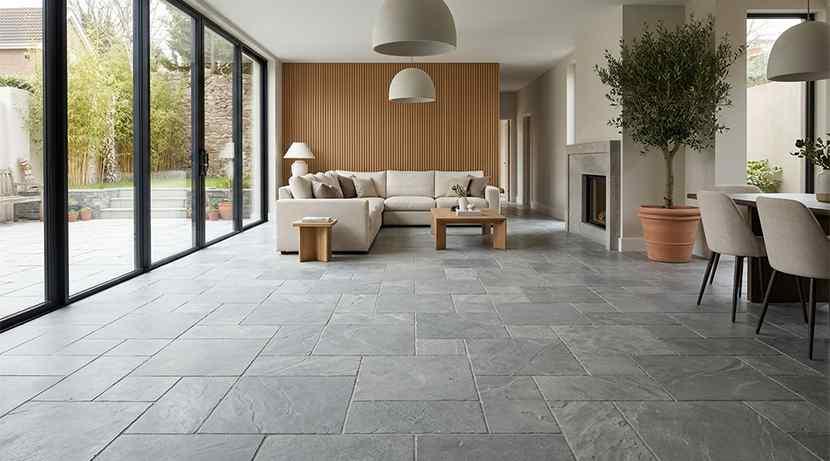
Alongside the classic honey-beige colourway, a grey Dijon Limestone variant is also available for those wanting the same fossil detail and matte surface character but a cooler, more neutral base tone; useful where the wider scheme leans grey rather than warm-toned.
It’s worth noting that Dijon Limestone also exists in outdoor-rated formats, including cobbled setts and heritage antiqued paving slabs. However, Dijon Limestone pavers are built for exterior wear and are a separate specification decision from the indoor tiles covered in this guide.
More on creating seamless transitional spaces between indoors and outdoors: How to Create Seamless Indoor-Outdoor Living in Your UK Home
Why Designers Specify Dijon Limestone for UK Interiors
Interior designers rarely specify tiles based on the colour only. Dijon Limestone’s matt finish diffuses light rather than bouncing it, which matters in UK homes where natural light is often limited and glare from highly reflective floors makes a room feel harsher than brighter.
Dijon Limestone Tiles for Kitchen
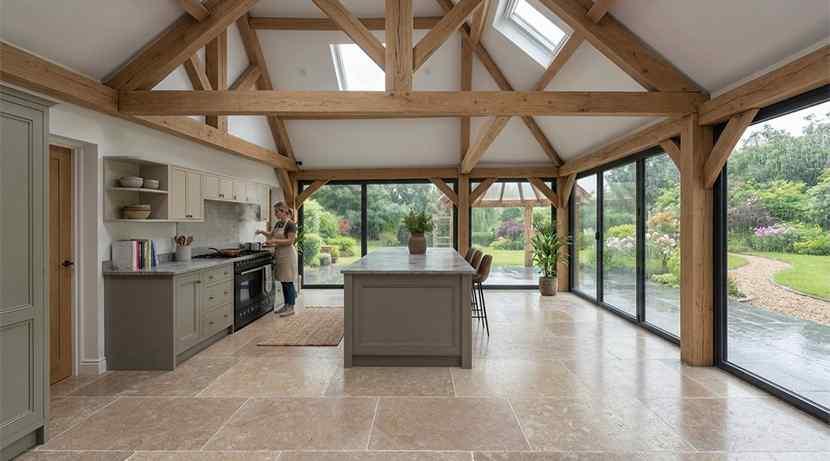
In schemes built around kitchen tiles, that low-glare quality pairs really well with warm-toned cabinetry and brass or brushed metal fittings, without the coldness that porcelain-look grey stone can introduce.
Dijon Limestone Tiles for Bathroom
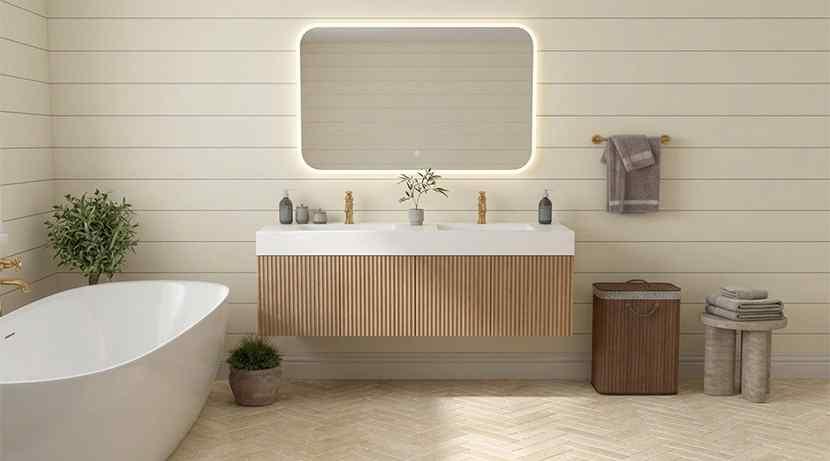
For bathroom tiles application, the tonal warmth of Dijon limestone, specifically Dijon herringbone tiles, offsets the clinical feel that creeps into all-white bathroom schemes, while its natural texture gives a honed or lightly tumbled finish underfoot rather than a glass-smooth one. Dijon Limestone for Living Rooms
Dijon Limestone for Living Rooms
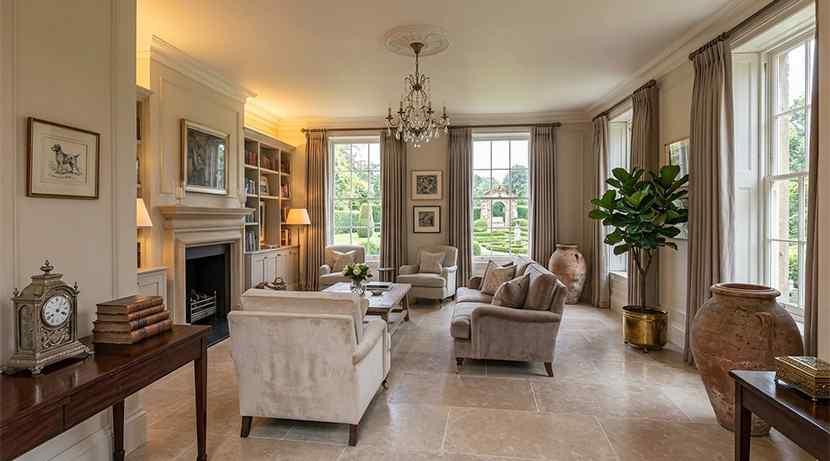
For living room tiles, designers frequently point to the stone’s compatibility with both contemporary open-plan layouts and traditional British housing stock, Victorian hallways, converted barns, and period cottages, where a uniform, factory-perfect finish would look out of place next to original features like exposed brick or timber beams.
Across all three applications, Dijon limestone does not force a single design direction. It supports Scandinavian-minimal schemes and traditional English interiors with equal credibility, which is precisely why it turns up across such a wide range of specification briefs.
Durability and Performance in British Homes
Limestones, including Dijon Limestone, as a material, sit at 3 or 4 on the Mohs hardness scale. They are softer than granite or porcelain but entirely serviceable for domestic indoor flooring when properly sealed and maintained.
Dijon Limestone durability in British homes depends less on the stone’s raw hardness and more on sealing at installation and a sensible sealed schedule. This is the detail that gets skipped in a lot of DIY installs and causes problems years later.
Sealing limestone is important, as naturally it absorbs water and is highly porous. Unsealed or poorly sealed tiles will absorb spills and grease, potentially leading to staining in kitchens and bathrooms specifically. This is not a defect unique to Dijon Limestone, but all the natural stones in the same family. It is the single most important maintenance fact that a UK homeowner needs before committing to it for indoor floors.
Installation Considerations for UK Properties
When you install limestone tiles correctly, you ensure they perform well throughout their lifespan. UK housing stock introduces some specific variables worth planning around.
Sub-floor Preparation
Limestone tiles require a flat, stable and fully cured subfloor. In old British properties with solid or suspended timber floors, this often means additional screeding or overboarding before tiling begins. Skip this step and destine your floor tiles to lippage and grout lines to crack after a year or two of use.
Adhesive Selection
Natural stone tiles need flexible yet high bond cementitious adhesive rated specifically for natural stone rather than a standard ceramic adhesive.
Off-white or stone-specific formulations are preferable to grey adhesives, which can shadow through the lighter and more porous face of the tile. It is a particular risk with warm-toned stone like Dijon Limestone.
Bedding and Expansion Gaps
A full solid mortar bed is preferred rather than spotting for any natural stone floor tile, and perimeter expansion gaps should be maintained to accommodate minor thermal movement; particularly relevant where underfloor heating is installed.
Dijon Limestone floor tiles are compatible with underfloor heating systems, which is one of the reasons it appears so often in modern UK renovation projects. However, one must keep in mind that the heating system should be commissioned gradually per manufacturer guidance before gradually grouting to avoid thermal shock.
Limestone’s natural density also means it retains heat well once warmed, which some homeowners find reduced reliance on central heating day to day:
One homeowner shared their personal experience after installing Dijon Tumbled Limestone:
“Our beautiful Dijon Tumbled Limestone is a showstopper, no doubt about it. If you leave underfloor heating running low, it can reduce your need for central heating to a point, especially if your stone retains heat easily like Limestone does.“
Grout Choice
Choose grout colour close to tiles’ natural tone to avoid visually fragmenting the floor. Use a non-acidic stone-safe grout throughout. The same considerations apply when installing wall tiles, particularly Dijon Limestone on splashbacks or feature walls.
Sealing, Cleaning and Long-Term Maintenance
With Dijon Limestone flooring, sealing is not optional, but a mandatory step. Apply an impregnating sealer after installation and grouting. It penetrates the stone to reduce porosity without altering anything about the colour composition and appearance. Reseal frequency depends on the footfall and use of the room. For high-traffic hallways and kitchens, reseal more often than a lower-traffic living room.
If you are wondering how to check if your limestone flooring needs to be sealed, do a simple droplet test. If the water beads, it doesn’t yet need sealing. If it soaks the floor, it is time to reseal the Dijon limestone floor. This is a reliable way to check whether the reseal is due or not.
Day-to-day cleaning of limestone flooring relies on pH-neutral cleaning products. Acidic cleaners like vinegar, lemon-based sprays, and many generic bathroom cleaners will etch the calcium carbonate surface, leaving dull patches that are difficult to reverse.
“Protective sealant can be used to aid durability, but even then it is difficult to keep the stone in perfect condition. Therefore, natural stone like limestone should only be used if you genuinely love the look of it” – Hayley Coburn, Interior Designer.
This single point caused more avoidable damage to limestone floors than almost anything else, and it is worth flagging clearly to anyone else who cleans the property.
Dijon Limestone vs Porcelain: An Honest Comparison
The limestone vs porcelain floor tiles question comes up in most specification conversations, and the honest answer is that they solve different problems.
Neither of the options is objectively superior; the choice depends on whether the priority is minimal upkeep or material character.
| Flooring type | Surface character | Maintenance | Best suited for |
| Dijon Limestone | Matte, natural fossil detail, genuine tonal variation tile to tile | Requires sealing at installation, periodic resealing, pH-neutral cleaners only | Homeowners prioritising material authenticity over low upkeep |
| Porcelain | Hard, non-porous, highly consistent colour reproduction | No sealing needed; low ongoing maintenance | Those prioritising minimal upkeep over natural variation |
| Travertine-effect tiles | Heavily pitted, pronounced texture, warm neutral palette | Comparable natural-stone care considerations | Similar tonal palette to Dijon Limestone with more surface texture |
| Marble-effect tiles | Polished, veined, formal appearance | Lower-maintenance surface than natural limestone | Formal or luxury-led interiors |
Room-by-Room Suitability
You can use Dijon Limestone for any floor in your home, given that you take all the precautions that are required for that space and Dijon Limestone tiles.
- Kitchens: It performs well provided sealing is maintained religiously. Spill resistance depends entirely on sealer condition, so this is the room where reseal schedules matter the most.
- Living Rooms: Lower footfall and fewer spills make this the easiest room for limestone. It also pairs perfectly well with underfloor heating on cooler evenings.
- Hallways: The highest traffic area in most homes, hallways benefit from a lightly textured rather than fully honed finish to reduce slip risk where the floor is damp from wet shoes or umbrellas. It is one of the most genuinely practical considerations in UK weather.
- Bootrooms & Utility Spaces: These take the heaviest daily wear of any room in the house, and the stone’s natural fossil detail tends to age well under exactly that kind of use rather than showing it as damage:
To Sum It Up
Dijon Limestone earns its place in interior design briefs through material authenticity rather than novelty. The warm, matte, and genuinely variable natural stone look suits all UK homes ranging from period cottages to modern new-built homes.
Its long-term performance depends almost entirely on correct installation and a realistic maintenance routine, rather than on the stone itself.
For homeowners and contractors weighing it up, Dijon Limestone tiles remain one of the most design-flexible natural stone options at Royale Stones of the UK for indoor flooring.
You can either buy Dijon Limestone online or visit our nearest showroom to see the texture and the colour for yourself.
FAQs on Dijon Limestone Floor Tiles
Is Dijon Limestone suitable for indoor flooring in UK homes?
Yes. The warm, neutral tone and matt surface of Dijon limestone suit both contemporary and traditional UK interiors. It is compatible with underfloor heating systems and high-traffic indoor spaces, provided it is sealed correctly at installation.
How durable is Dijon Limestone compared to other natural stones?
Dijon Limestone is softer than granite and porcelain but entirely durable for domestic floor usage when properly sealed and resealed on a schedule matched to footfall.
What adhesive and installation method should be used for Dijon Limestone tiles?
Use a flexible and limestone-specific cementitious adhesive on a fully solid bed method with appropriate perimeter expansion gaps in between.
What is the use of limestone in interior design?
The natural texture and muted tone of tumbled Dijon limestone make it ideal for creating elegant facades, feature walls, and minimal interiors in the form of indoor floor tiles and wall tiles. The limestone’s thermal properties help maintain a comfortable indoor temperature, making it an energy-efficient choice for buildings.