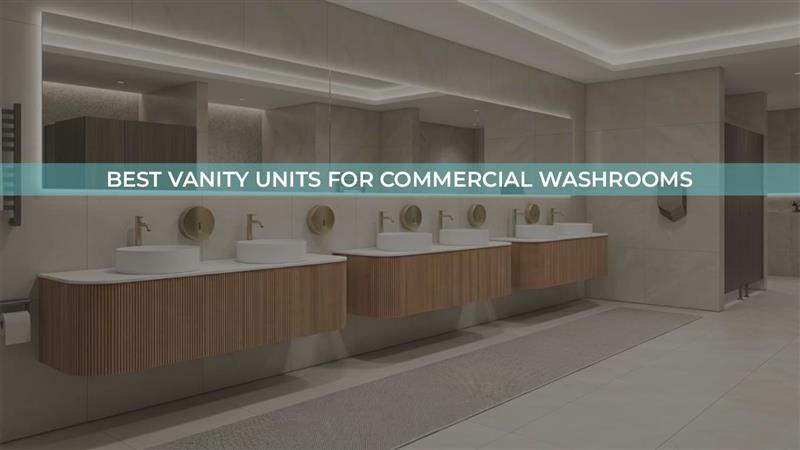
Best Vanity Units for Commercial Washrooms
According to the British Washroom Association, the average commercial washroom serves between 50 and 200 users per day; a load that renders domestic-grade fittings inadequate within months.
Commercial washrooms are no longer just a functional space. Boutiques, corporate offices, schools, leisure centers, and restaurant groups expect specifiers and facilities to deliver spaces that are hard-wearing and also portray a professional image.
A commercial vanity unit sits at the heart of this challenge. It must withstand daily heavy use, meet high hygiene expectations, satisfy accessibility rules and at the same time look good in the overall aesthetic and clean washrooms.
The best commercial vanity unit matters in specification as well as selection. Royale Stone UK supplies a comprehensive range of bathroom vanity units and washroom solutions, customized according to the needs of UK commercial settings.
From single basin installation in offices to multi-unit fitouts across educational and hospitality arrangements, let’s explore your options:
Aspects That Make a Vanity Unit “Commercial-Grade”
There are certain key differences between domestic vanity units and commercial-grade vanity units. For commercial vanity units, they have a set of performance criteria:
1. Load-Bearing Capacity
Commercial bathroom sink units experience far greater stress than residential counterparts. People lean on them, place heavy bags and equipment, and there are hundreds of interactions each day.
That is why modern technology has built commercial units’ carcasses from durable and moisture-resistant MDF, solid timber or powder-coated steel. These are not mere upgrades, but requirements for longevity and long-term maintenance.
2. Material Resilience
The strength of the material extends from carcasses to surface treatments. The commercial washroom products need to have anti-bacterial laminate, non-porous worktop materials that are easy to clean as part of best practices.
The surfaces must be able to endure repeated commercial cleaning agents without signs of degradation. They must be water and moisture-resistant as commercial washrooms receive high occupancy, where splashes and condensation are just another Tuesday.
3. Compliance with Commercial Regulations
When it comes to compliance, UK installations must comply with Building Regulations Part M and BS 8300 Standards of Accessibility, including basin height, knee clearance for wheelchair users, and suitable tap operations.
The compliance states as follows:
- Building Regulations Part M (2015) sets out accessibility requirements, including a basin centreline height of 720–740mm for ambulant users and 720mm for wheelchair users, alongside knee clearance of at least 700mm.
- BS 8300:2018 goes further, covering reach distances, tap operation force limits, and contrast requirements for visually impaired users.
- For schools specifically, BB87 (Area Guidelines for Mainstream Schools) informs washroom sizing and provision ratios.
A professional commercial bathroom vanity unit supplier advises compliance with configuration regulations without excuses. Non-compliance risks costly remedial work post-inspection and, in publicly funded projects, procurement rejection.
4. Ease of Maintenance
For long-term satisfaction of the facilities team and hygienic public washrooms, choose finishes you can clean fast and maintain cheaply. This is non-negotiable in a commercial setting.
In order to reduce labour costs associated with routine cleaning and repairing, the following are important considerations:
- Accessible plumbing connections
- Demountable fascias
- Concealed fixings
- Non-porous tops and materials
In residential settings, they are not as necessary, but when it comes to commercial washrooms, they are central to refurbishment planning.
Types of Commercial Vanity Units
There is no single answer to the specification of a commercial vanity unit. The most appropriate commercial vanity unit depends on the area of use, the traffic that it receives, the available footprint and the design intent of the wider fit-out.
We have sorted out five principal vanity unit types available in the UK commercial market.
1. Wall Hung Vanity Units
When one imagines a corporate office, a professional service environment, or a modern hospitality space, they think of a wall-hung vanity unit as a standard choice.
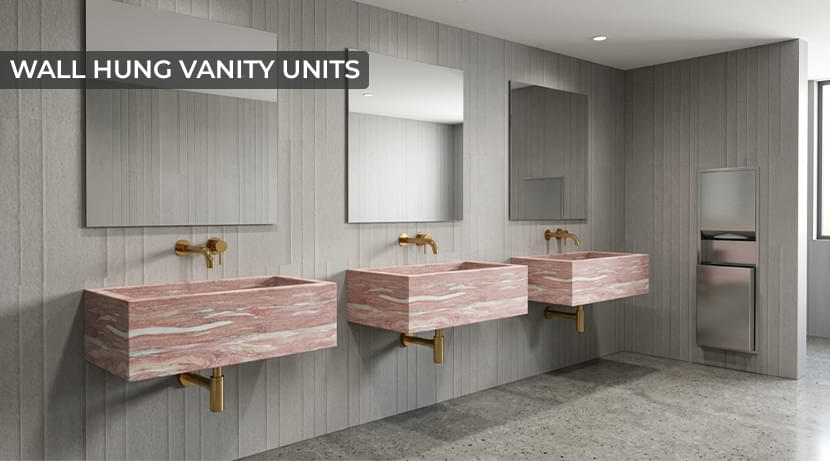
The lifted carcass:
- Frees up floor space
- Eliminates the gap where moisture and dust can accumulate on floors
- Simplifies floor cleaning
- Gives an uncluttered quality to the space
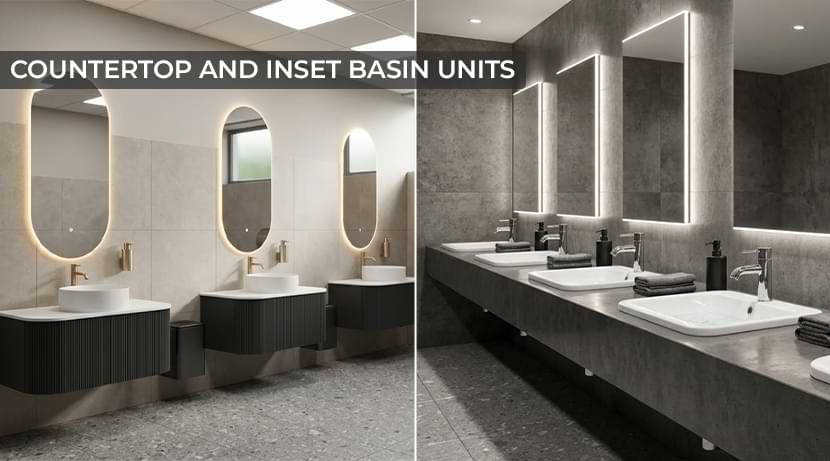
2. Countertop and Inset Basin Units
In hospitality sectors, i.e., hotels, spas, members’ clubs, and executive washrooms, countertops or inset basins deliver a premium look as expected by the members and guests using them. Here, the vanity unit acts as a frame for the basin selected, and the quality of the worktop plays a crucial role, working as a design statement.
As EJ Chung (Gensler, Principal and Design Director) puts it:
“It doesn't matter whether you're designing or specifying... you want to make sure the product is durable, cleanable, and safe”.
It's a standard that applies equally whether you're fitting out a boutique hotel or a secondary school washroom.
He is able to resolve this by specifying porcelain-cladded units with quartz worktops; a combination that passed the client's infection-control audit on first review.
For the sake of durability and design, porcelain, quartz, and natural marble basins are preferred multiple times, elevating washrooms into an interior moment rather than a functional afterthought.
This approach works with the best vanity units for bathrooms in high-end hospitality settings where visual impact matters as much as performance.
3. Combined Vanity and Toilet Units
When you are working with a limited floor area, for instance, compact commercial cubicles, single-occupancy accessible rooms, or pod-style washroom installations, you need to get creative, and that includes finding the best vanity unit for small bathrooms.
In such compact spaces, the washrooms can benefit greatly from a combined vanity with toilet units. They offer smart space planning solutions. Combined vanity and toilet units consolidate the vanity unit, toilet and storage space into a cohesive assembly unit, reducing individual elements that need to be specified, delivered and installed
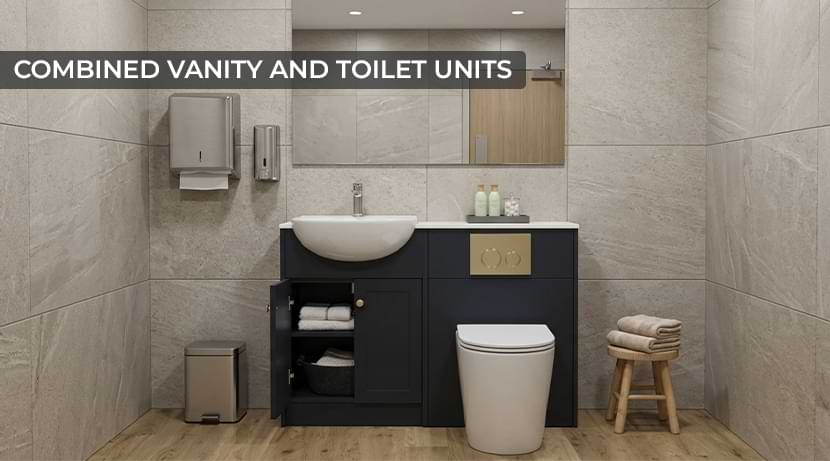
If you are a facility manager overseeing multiple identical rooms, toilet and vanity unit consistency and efficiency can simplify ongoing maintenance considerably.
4. Multi-Basin and Wash Trough Units
Single basin vanity units are simply impractical in schools, gyms, stadiums, and transportation hubs, as they operate on a very large scale. Multi-basin configurations and commercial vanity units with wash troughs are specifically designed for this purpose. People can simultaneously use them, reducing queues during peak hours.
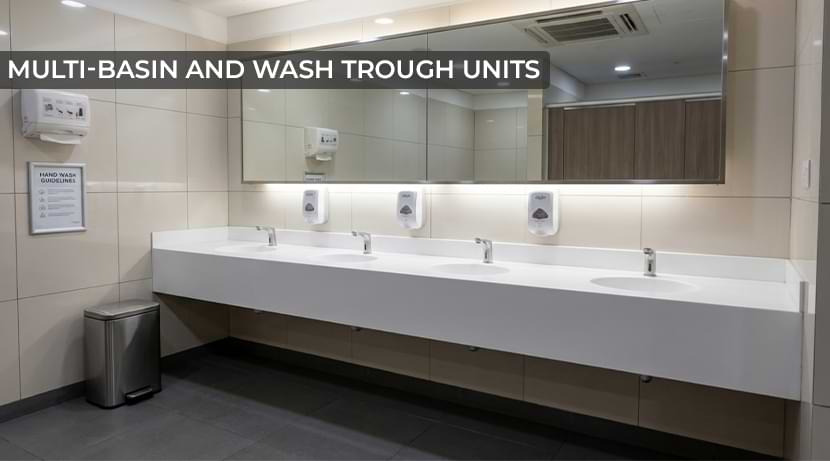
The most common is a 3-sink commercial vanity unit, comprising a single, seamlessly joined run that minimise gaps where bacteria can harbour. They also present a clean and cohesive look in public washrooms.
A commercial double vanity unit is an entry point of this category, but longer runs are ideal for washroom spaces receiving crowds during peak hours.
5. Porcelain Cladded Sink Vanities
Porcelain-cladded vanities are gaining popularity as they combine the structural integrity of traditional carcass with hygienic and visual properties of porcelain finish.
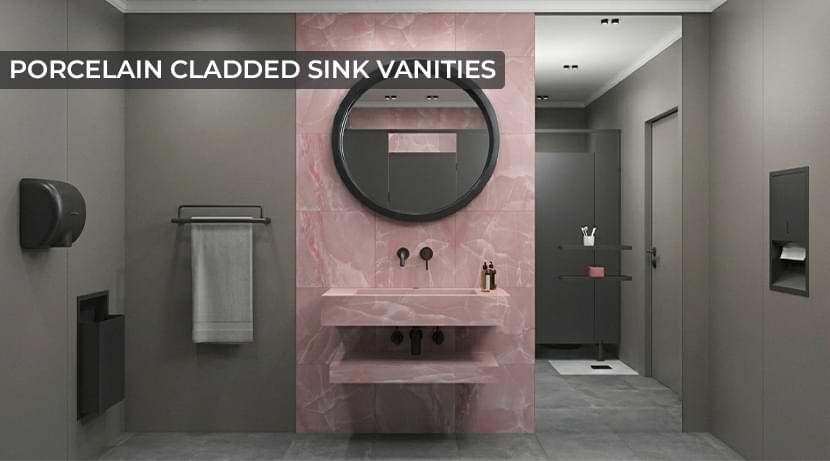
These sinks are easy to clean and maintain. They are highly resistant to chemical cleaning agents and present a seamless, grout-free surface suited for strict infection-control environments.
Porcelain-cladded sinks are also gaining traction across healthcare adjacent settings, premium leisure facilities, and design-led hospitality environments where aesthetics are as non-negotiable as hygiene.
Best Vanity Units for Schools and Education Settings
With over 24,000 state schools in England alone (DfE, 2024), the education sector represents one of the largest recurring demand pools for contract washroom specification in the UK.
The education sector has a unique set of procurement challenges, demanding meticulous considerations in specification. School vanity units must withstand rougher treatment than other commercial environments.
Durability and Resilience
The vanity units must have high tolerance and physical resilience to withstand challenges. They must have:
- Strength as a baseline requirement, not an upgrade
- Anti-slam doors and drawers to reduce wear from daily heavy use
- Robust hinges rated for high-cycle commercial operation
- Solid core carcasses (Preferred over foil wrapped alternatives)
- Non-porous surface material
- Resistant to scratches from markers, pens, or cleaning products.
Compliance and Accessibility
According to the UK Standards of Accessibility,
- The height of the basin must comply with Building Regulations Part M and BS 8300.
- Compliance requirements vary across primary, secondary, and higher education settings.
- The surfaces must be easy to clean and maintain to support hygienic standards across high-occupancy pupil washrooms.
Procurement and Supply
For facility managers and procurement leads, sourcing a single commercial bathroom vanity units supplier delivers measurable operational advantages, such as:
- Consistent specifications of units across multiple sites
- Simplified logistics for bulk supply requirements
- A single point of contact for product queries, replacements, and ongoing support.
Royale Stones UK supplies vanity with basins suitable for school fit-outs at scale.
Secondary School Washroom Refurbishment, West Yorkshire Challenge
6 student washrooms requiring full replacement across a live school site.
Solution: Wall-hung 3-basin trough units in moisture-resistant MDF with sensor taps.
Outcome: Installed across a 3-week summer window; zero maintenance callouts in the first academic year.
While the best vanity unit for a small staff bathroom differs from the student washrooms, the criteria of durability, hygiene and compliance remain the same throughout.
How to Choose The Right Basin and Tap for a Commercial Vanity
The vanity unit is only a part of the whole specification. In commercial settings, the basin and tap pairing is equally consequential in terms of hygiene, performance, and long-term durability.
Basin Formats
Below are the types of basins that can be selected in relation to the vanity unit:
- Inset Basins: Best for countertop units in hospitality environments.
- Semi-recessed Basins: Practical for limited worktop depth.
- Under-counter Basins: Offer the cleanest surface profile – best for premium office washrooms.
- Trough Basins: A practical choice for multi-user commercial bathroom sin configurations like schools, gyms, public washrooms.
Tap Specification for Commercial Settings
Commercial washroom taps have different requirements from those of domestic practice:
- Sensor and Infrared Taps: Now a standard in new commercial washrooms, eliminating touchpoints and reducing cross-contamination risks.
- Thermostatic Controls: A regulatory requirement in schools, care homes, and anywhere where the users are vulnerable.
- WRAS-approved Fittings: Compliance with Water Supply (Water Fittings) Regulations 1999 (Must be treated as minimum standard, not an optional quality maker)
- Solid Brass Internals: Outlasts plastic cartridge alternatives in a commercial restroom sink environment.
Note: WRAS approval (Water Regulations Advisory Scheme) is a legal requirement under the Water Supply (Water Fittings) Regulations 1999, not a quality badge. Specifying non-WRAS-approved fittings in a UK commercial setting exposes the building owner to enforcement action from the local water undertaker.
Commercial Vanity Units Pricing
Cost is obviously a clear decision-making factor in commercial procurements, but vanity units and other bathroom accessories must be evaluated on lifetime value rather than upfront costs.
A 2023 CIBSE guidance note on washroom maintenance estimated that premature fixture failure in commercial settings costs facilities teams an average of 3–5× the original unit cost when labour, disruption, and replacement are factored in.
Vanity Unit Pricing Tiers for Different Budgets
Entry-Level Contract Vanities – ~£200–£600 per unit (Excluding basins and taps)
- They provide great functionality without focusing on the aesthetics
- Appropriate for back-of-house facilities, industrial settings and large-scale installations where budget is key.
- Performance and cost-efficiency are a priority rather than the visual impact.
Mid-Range – ~£600–£1,500 per unit
- The most common specification tier for hospitality, corporate, and educational projects
- Accommodates design-led finishes and more robust carcass construction
- Broader choice of basin integration
- A commercial double vanity unit can present an excellent value across multiple rooms.
Premium and Custom – £1,500 and upwards per unit
- Custom stone worktop finishes, dimensions and luxury-grade materials
- Brand impression requirements of high-end environments
- A 3-sink commercial vanity unit here represents a long-term asset rather than just a functional fixture
Royale Stones UK recommends choosing the range based on the commercial budget, functionality requirements, number of people using the washrooms, and priorities of aesthetics and performance determination.
Disclaimer! Pricing varies by configuration, finish, and project scale. Contact the Royale Stones team for a current specification quote tailored to your project.
Finishing Touches – Tiles, Flooring, and Full Commercial Washroom Picture
A commercial vanity unit doesn't exist in isolation. It is surrounded by wall tiles, floor finishes, and an overall material palette. Combined, they directly affect the vanity unit’s looks within the space and how the washroom performs as a whole.
Commercial Washroom Tile Selection
It depends on the looks and functionality you are looking for. Here are some of the recommendations from our side to complete the look by adding the most appropriate indoor tiles.
| Tile Type | Key Benefit | Best Suited For |
| Large-format porcelain wall tiles | Seamless, easy-clean backdrop that reinforces hygienic credentials | Behind vanity runs in commercial washroom installations |
| Natural stone tiles | Complements premium vanity specifications with a refined finish | Hospitality and executive washroom environments |
| Slip-resistant porcelain or stone floor tiles | Practical underfoot safety with visual cohesion across the wider palette | All commercial washroom floor applications |
Our full bathroom rangeallows clients to source vanity units, basins, taps and tiles in one place. We simplify the specification process without any compromise on choice or quality.
Specifying with Confidence
When you choose the right commercial vanity unit from a single commercial bathroom vanity units supplier, you automatically balance durability, hygiene compliance, design quality, and long-term value. The appropriate specification will always be specific to the project at hand.
A school refurbishment demands different criteria from a boutique hotel fitout and a transport hub installation, which is a world away from a corporate headquarters' washrooms. Every project is different. Get the specification right the first time, and you won't be revisiting it in 18 months.
To explore the full range or discuss your project requirements, visit the Royale Stones UK website or contact the team directly for tailored specification advice.
FAQs About Commercial Vanity Units
What is the most durable vanity for a bathroom?
Most durable bathroom vanities have solid-core carcasses made of moisture-resistant MDF, solid timber, or powder-coated steel. They are paired with non-porous surface finishes such as porcelain cladding or high-pressure laminate. In commercial settings, wall-hung vanity units with anti-bacterial surfaces and concealed fixings consistently outperform freestanding alternatives in terms of longevity.
What is the current trend for bathroom vanities?
The dominant trend in bathroom vanity design for 2026 is the move towards clean, material-led minimalism. There is an emphasis on tactile finishes over decorative detail. Fluted oak and walnut cabinetry continues to be popular in both residential and boutique hospitality settings, whilst porcelain-clad vanities are gaining significant traction in commercial fit-outs for their seamless, grout-free aesthetic.
- Bathroom Tiles
- Porcelain Paving
- Bathroom Vanity Units
- Floor Tiles
- Garden Paving
- Kitchen Tiles
- Porcelain
- Wall Tiles
- Natural Stone Paving
- Onyx Tiles
- Paving Slabs
- Sandstone Paving
- Marble Tiles
- Terrazzo Tiles
- Anti Slip Tiles
- Wood Effect Paving
- Paving
- Exterior Floor Tiles
- Outdoor Tiles
- Outdoor Porcelain Tiles
- Brick Effect Tiles
- Bathroom Basins
- Stone Effect Wall Tiles
- Indoor Tiles
- Vinyl Flooring
- acoustic wall panels
- Porcelain Tiles
- Dijon Limestone
- Vanity Units
- Knowledge Base
- Inside Out Tiles
- Porcelain Paving Slabs
- Slate Effect Tiles
- Concrete Effect Tiles
- External Wall Tiles
- Wood-Effect Tiles
- Victorian Floor Tiles
- Luxury Tiles
- 3D Split face Wall Tiles
- Outdoor Porcelain Paving
Recent Post
-

Large-Format vs Small Paving Slabs: Which is Best for Your UK Garden?
October 9th, 2026 -

Limestone OR Limestone-Effect Porcelain – Which One Is Better?
October 9th, 2026 -

Low-Maintenance Patios: Why More UK Homeowners Are Choosing Porcelain
September 22nd, 2026