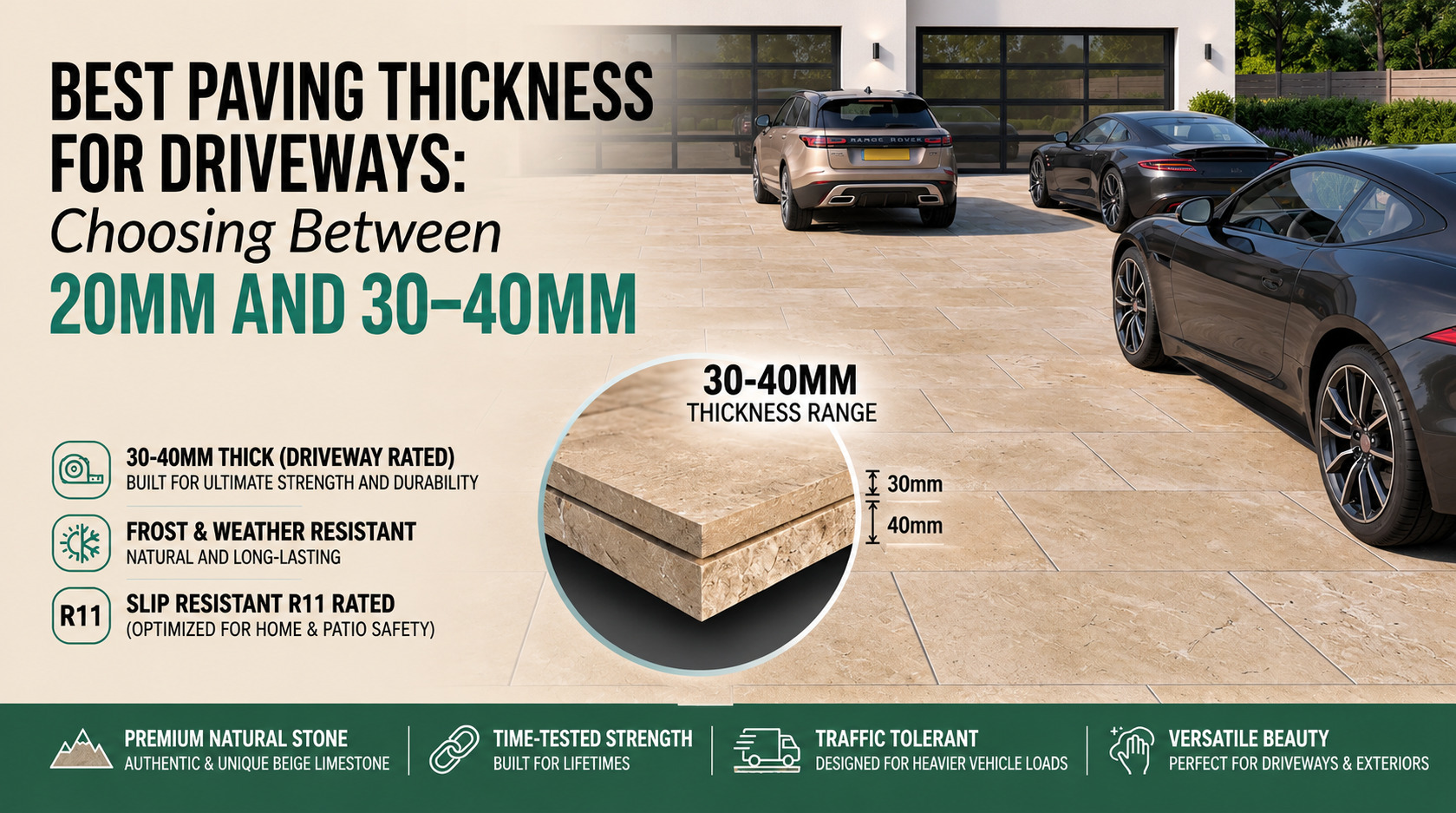
Best Paving Thickness for Driveways: Choosing Between 20mm and 30–40mm
Why Thickness Matters More Than You'd Think
Not all paving is created equal. Indoor tiles are typically 8mm to 10mm thick, designed purely for foot traffic on a flat, supported floor. Once you move outdoors, and especially onto a driveway, that thickness cannot cope with vehicle loads, ground movement, or repeated freeze-thaw cycles.
This is why every reputable UK supplier, including Royale Stones, sells outdoor paving slabs at a minimum of 20mm thickness. At this depth, porcelain is manufactured using high-pressure compaction and fired at extremely high temperatures, giving it a breaking strength that comfortably exceeds what a patio will ever demand. It's the same 20mm standard used across garden patio tiles and general garden paving, simply put through more rigorous quality checks for everyday use.
However, when it comes to a driveway, it hugely depends on the load-bearing capacity and the installation method used. It is recommended to go for thick, driveway-rated paving material like limestone that offers a robust surface for vehicular loads. Slabs with 30 mm or more of thickness are generally a suitable choice. A 20 mm pavement is simply not thick enough to handle the driveway traffic.
Qualities to Look For in Driveway Paving
Three properties determine whether a paving material can handle a driveway:
- Breaking Strength and Thickness: Quality 30-40 mm natural stone slabs have a thick surface that handles the load pretty well, giving them a breaking strength well in excess of what's needed to support car and light van traffic when laid on a proper sub-base.
- Weather Resistance: British weather can be unpredictable. Go for material that withstands the unreliability of UK weather and performs simultaneously. A high-quality natural stone will do the heavy lifting for your driveway.
- Grip and Surface Finish: A driveway gets wet, oily, and muddy far more often than a patio. Look for a textured and slip-resistant material that is designed to provide safe grip even in wet or greasy conditions, which matters when you're carrying shopping bags across it in the rain.
Other Driveway Materials
If you're considering options, here are some other choices besides porcelain paving.
- Natural Stone paving slabs - Natural stone, including limestone, granite, and sandstones, is one of the hardest, frost-resistant materials available and remains an excellent driveway choice where a heavier, more traditional look is preferred.
- Block pavers - Block paving flexes slightly with ground movement, which some installers see as an advantage on driveways. Natural stone pavers, laid correctly on a properly designed base, can accommodate vehicular traffic.
- Slim sett pavers - Slim setts work brilliantly for edging, borders, or defining the transition between a driveway and garden paving. They can also be used on a driveway to carry vehicle loads on their own. Many homeowners pair 30-40 mm paving for the main driveway area with slim sett pavers as a border detail.
What About the Look?
Strength doesn't mean sacrificing style. Thicker driveway paving is available in a wide range of finishes and materials, from clean contemporary limestone to natural stone designs. If your driveway leads onto a patio finished in something like Dijon Limestone, a natural paving in a matching tone can create a seamless, high-end look from the front of the house right through to the garden, without the sealing and upkeep that natural limestone requires outdoors.
Final Verdict: What To Choose Between 20mm and 30–40mm
When it comes to driveway paving, choosing the right thickness is more important than just the looks. A 20 mm thick paving stone is an excellent choice for patios and terraces, but to assume it is suitable for a driveway is wrong.
A good outdoor-grade 30-40 mm thick stone paving, correctly installed on a proper sub-base, is more than strong enough for a standard domestic driveway. Its high breaking strength and textured surface make it a genuinely durable choice for UK weather conditions, not just a patio material dressed up for a bigger job.
The two things that make or break the result are the quality of the paving itself and the standard of the groundwork beneath it. Get both right, and a driveway can outlast and outperform many alternatives.
Thinking about a driveway? Explore Royale Stones' full range of driveway paving, garden paving, and paving slabs online, or visit one of our UK showrooms to see samples and finishes in person before you order.
- Bathroom Tiles
- Bathroom Vanity Units
- Porcelain Paving
- Floor Tiles
- Kitchen Tiles
- Garden Paving
- Porcelain
- Wall Tiles
- Natural Stone Paving
- Onyx Tiles
- Paving Slabs
- Sandstone Paving
- Anti Slip Tiles
- Terrazzo Tiles
- Marble Tiles
- Brick Effect Tiles
- Wood Effect Paving
- Paving
- Exterior Floor Tiles
- Outdoor Tiles
- Outdoor Porcelain Tiles
- acoustic wall panels
- Bathroom Basins
- Indoor Tiles
- Vinyl Flooring
- Stone Effect Wall Tiles
- External Wall Tiles
- Dijon Limestone
- 3D Split face Wall Tiles
- Vanity Units
- Outdoor Porcelain Paving
- Knowledge Base
- Luxury Tiles
- Inside Out Tiles
- Victorian Floor Tiles
- Slate Effect Tiles
- Porcelain Paving Slabs
- Concrete Effect Tiles
- Porcelain Tiles
- Wood-Effect Tiles
- Tumbled & Chiselled Tiles
- Tile Installation Tips
Recent Post
-
7 Reasons to Choose a Wooden Vanity Unit for Your UK Bathroom
November 2nd, 2026 -
 October 31st, 2026