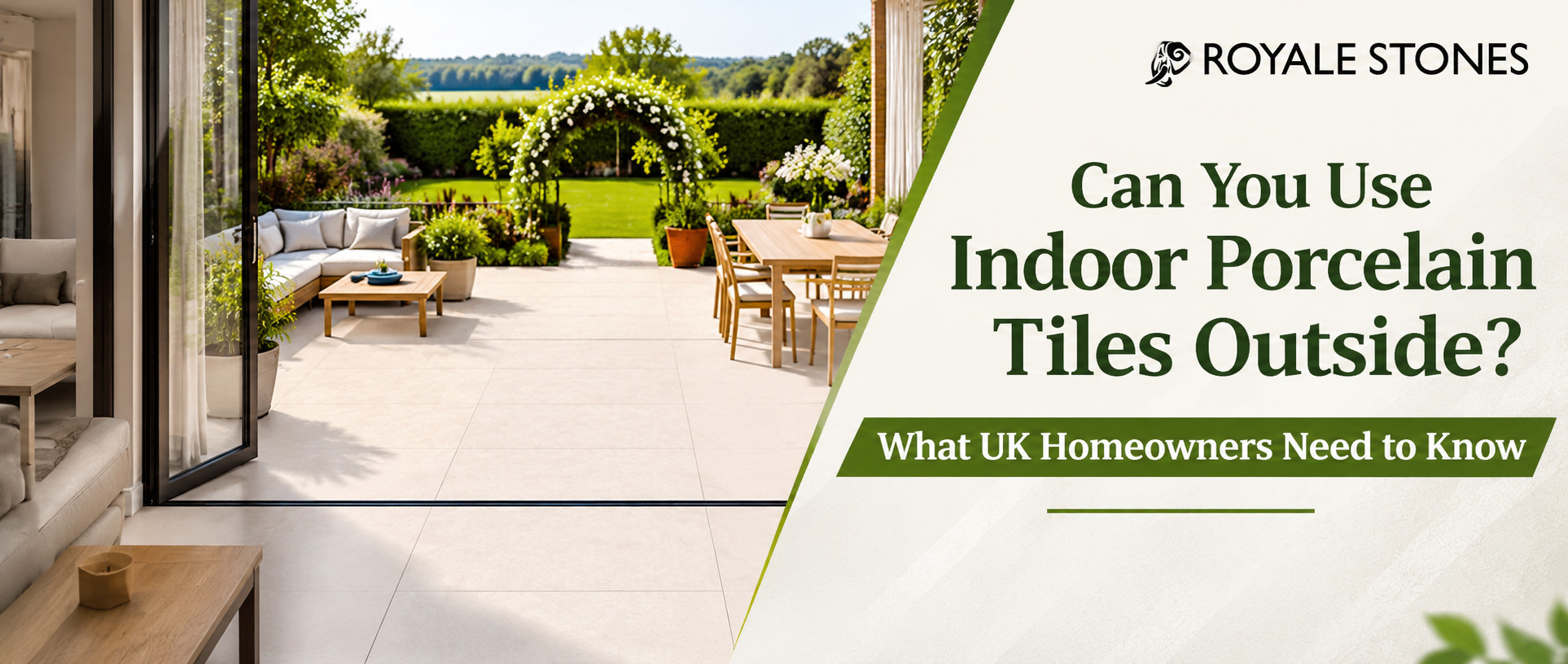
Can You Use Indoor Porcelain Tiles Outside? What UK Homeowners Need to Know
It is easy to fall for an indoor porcelain tile and picture it running straight out through the patio doors. Before you order, though, it helps to know that indoor and outdoor porcelain are designed for very different conditions, and the wrong choice can crack, turn slippery or lift within a few winters.
Quick answer: in most cases, no. Indoor porcelain is typically around 10mm thick, has a surface chosen for easy cleaning and is not designed for frost, heavy loads or wet-weather grip. For a UK patio, choose outdoor-rated slabs, ideally 20mm thick with an R11 slip rating, or a matching indoor-outdoor range that offers both versions of the same design.
Garden patio tiles face conditions that a kitchen or hallway never sees, from frost and driving rain to heavy furniture and barbecues. That is why the specification matters more than the pattern. This guide explains the differences, when an exception might work and how to check a tile before you buy.
Why Indoor and Outdoor Porcelain Are Not the Same
Both are porcelain, so both have a dense, low-porosity body. The difference lies in how they are made and tested for their job.
| Indoor porcelain | Outdoor porcelain | |
| Typical thickness | Around 10mm | Commonly 20mm |
| Surface | Often smooth, honed or polished | Textured for grip |
| Slip rating | Varies, and often not tested for wet outdoor use | R11 or higher recommended |
| Frost resistance | Not always stated | Should be specified |
| Usual fixing | Thin layer of adhesive on a solid floor | Mortar bed, adhesive or pedestals |
Porcelain paving is therefore thicker, tougher and textured for wet conditions, which is what allows it to cope with a British winter.
Can Indoor Tiles Cope with UK Frost?
Frost is the biggest threat. When water gets into a tile or its fixing and freezes, it expands, and repeated cycles can make tiles crack, split or delaminate. Indoor tiles are rarely tested for this, so a mild autumn can hide a problem that only appears after the first hard winter. Outdoor porcelain is specified as frost resistant, and the product details should say so.
Why Slip Rating Matters Outside
Slip ratings run from R9, the lowest, up to R13. A patio is exposed to rain, algae and leaf mould, so R11 is widely treated as the minimum for outdoor use, and anything lower is a risk. Smooth or polished indoor finishes can feel fine in a dry hallway but become slick when wet.
At Royale Stones, our outdoor porcelain is R11 anti-slip rated and frost resistant, so you can compare it directly with any indoor tile you are considering.
Does Thickness Matter?
Yes. Indoor tiles are bonded to a flat, solid floor and rarely face heavy loads. Outdoors, a 10mm tile can struggle with furniture, planters, barbecues and the occasional wheelbarrow, even on a good base.
Outdoor-rated garden slabs are commonly 20mm thick, which gives them the strength for those loads and the flexibility to be laid on a mortar bed, with adhesive or on pedestals.
Can You Match Indoor and Outdoor Floors?
This is the best answer for anyone who wants a continuous look through bi-fold doors. Some ranges supply the same design in different specifications, with a thinner indoor version and a 20mm outdoor version. Many of our outdoor colours are also available as indoor tiles, so the floor can flow from room to garden.
Choosing garden tiles from a matching range keeps colour and pattern consistent while each version meets the demands of its location. Plan the threshold carefully, because the thicknesses differ, and make sure the outdoor surface falls away from the house.
To get the look right:
- Align the layout: line up joints and tile direction through the doorway
- Match the tone: order samples of both versions and view them side by side
- Accept a little more texture outside: it is there for grip, not decoration
When Might a Thinner Tile Work Outdoors?
Some suppliers sell slimmer indoor-outdoor tiles for sheltered, low-traffic spots such as a covered porch or side passage. Even then, check that the manufacturer states external suitability, frost resistance and a suitable slip rating. For an open patio that faces the weather, 20mm outdoor-rated slabs remain the safer choice.
How to Check a Tile Is Outdoor-Rated
Before you buy any paving slabs, look for these details on the product data sheet:
- Thickness: 20mm is the usual specification for patios
- Frost resistance: the tile should be stated as frost resistant
- Slip rating: R11 or higher, with test information if you need it
- Stated use: clearly approved for external use
- Fixing advice: guidance on adhesive, mortar or pedestals suited to porcelain
If any of these are missing, ask the supplier before you commit.
What Goes Wrong When Indoor Tiles Are Used Outside
- Cracking or splitting after the first cold, wet winter
- Slippery surfaces once rain, algae or leaves arrive
- Chips and breakage from furniture, planters or garden equipment
- Poor bonding when an indoor adhesive is used in outdoor conditions
Choose the Right Tiles with Royale Stones
Royale Stones is a UK supplier with roots in stone manufacturing stretching back more than 25 years, offering outdoor porcelain and indoor tiles from one place. You can order samples for £2.49 each to compare colour and finish in your own light, use the free tile calculator to add 10% for cuts, and visit our showrooms in Lincoln, Watford, Peterborough, Birmingham and Kent. We offer free pallet delivery to most UK postcodes, and trade customers can apply for a free Trade Account.
Frequently Asked Questions
- Bathroom Tiles
- Bathroom Vanity Units
- Porcelain Paving
- Floor Tiles
- Kitchen Tiles
- Garden Paving
- Porcelain
- Wall Tiles
- Natural Stone Paving
- Onyx Tiles
- Paving Slabs
- Sandstone Paving
- Anti Slip Tiles
- Terrazzo Tiles
- Marble Tiles
- Outdoor Porcelain Tiles
- Brick Effect Tiles
- Wood Effect Paving
- Paving
- Exterior Floor Tiles
- Outdoor Tiles
- acoustic wall panels
- Bathroom Basins
- Indoor Tiles
- Vinyl Flooring
- Stone Effect Wall Tiles
- External Wall Tiles
- Dijon Limestone
- 3D Split face Wall Tiles
- Vanity Units
- Outdoor Porcelain Paving
- Knowledge Base
- Luxury Tiles
- Inside Out Tiles
- Victorian Floor Tiles
- Slate Effect Tiles
- Porcelain Paving Slabs
- Concrete Effect Tiles
- Porcelain Tiles
- Wood-Effect Tiles
- Tumbled & Chiselled Tiles
- Checkerboard Tiles
- Tile Installation Tips
Recent Post
-
Laying Porcelain Paving Over Concrete: When It Works and When It Fails
November 13th, 2026 -
 November 6th, 2026